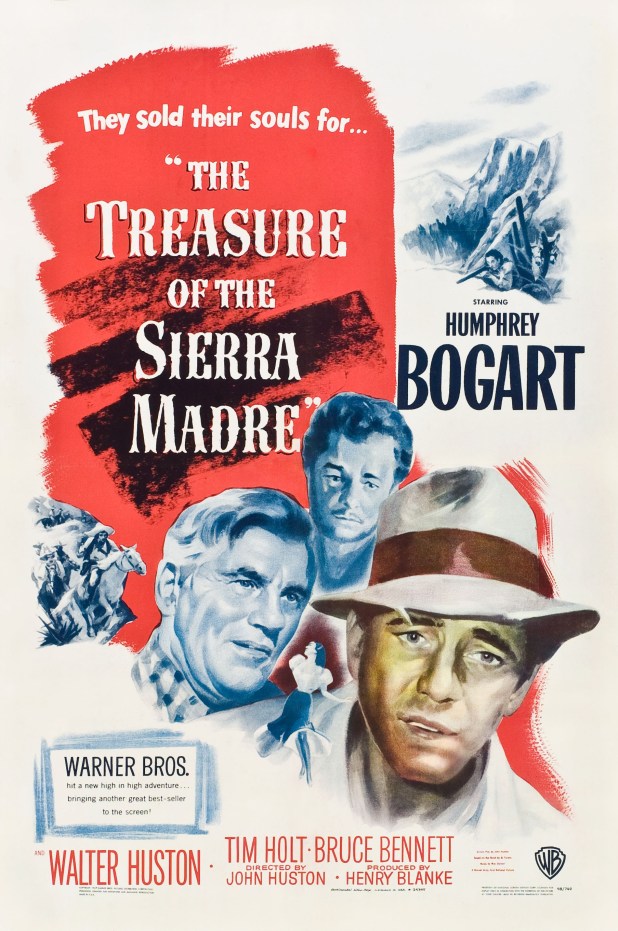
After reading the novel by B. Traven, director John Huston thought that it would make a great film. And he saw his father, Walter Houston, as the perfect lead.
He felt for the story, as it reminded him of his days in the Mexican calvary. Luckily, his first picture, The Maltese Falcon, was a success, so he was able to make this movie happen. Originally, the studio had George Raft, Edward G. Robinson, and John Garfield selected for the main three roles.
Then World War II — and Houston donating his time to make war effort documentaries — happened. When it was all over, Humphrey Bogart had become Warner Brothers’ top dog and he wanted in.
This was one of the first Hollywood films to be filmed on location outside the United States. Filming began in the state of Durango and also at Tampico, Mexico, where the only Spanish Bogie learned was “Dos Equis.”
For their work on the film, John Huston won Academy Awards for Best Director and Best Adapted Screenplay, with his father winning Best Supporting Actor.
Fred C. Dobbs (Bogart) and Bob Curtin are bums, getting by on spare change when they’re recruited by a labor contractor to help build oil rigs. The man skips on their pay. As they return home, they meet an old prospector named Howard (Walter Huston), who offers platitudes about god prospecting and how to get rich.
Between beating up their old boss for money and winning a small lottery, the men have enough to go in together to prospect for some gold in the hills of the Mexican interior.
What follows is an exhausting process that tries the men’s souls, as they’re forced to survive in near-unliveable conditions. However, they start adding up a fortune in gold. But now, Hobbs is gripped in the throes of worry — what if his partners screw him over?
Of course, there’s no way this ends up happy. Even as Howard is honored by the local village for saving a young boy, Hobbs is shooting their partner and trying to leave with the gold.
From mistaking a man trying to earn money for his wife as a killer to facing off with a band of Mexican criminals, the danger is real in every scene in this film. Hobbs is murdered by Gold Hat’s gang and his gold dust, worth so much that he’d kill his friends, is tossed into the wind. When the surviving Howard and Curtin realize this, all they can do is laugh.
Anton Lavey, founder of the Church of Satan, found that Walton Huston was well attuned to Satanic roles: “He was the only one who came out unscathed. He was the old geezer who knew the score, who was nobody’s fool when it came down to survival.”
Another Satanic viewpoint comes from Magus Peter H. Gilmore, current High Priest of the Church of Satan: “The Treasure of Sierra Madre is rather complex in realistically outlining human types, and ultimately, though the sought-after gold — a pipe dream Satanism would caution against — is lost, the characters receive ends befitting their deeds.”

 B&S About Movies