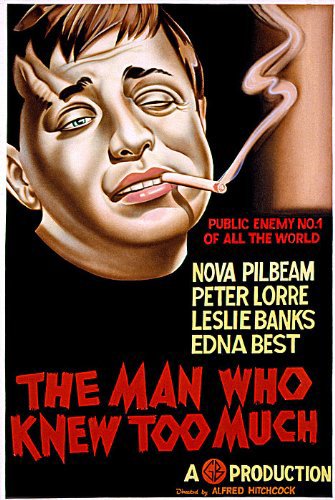
MILL CREEK LEGENDS OF HORROR: The Man Who Knew Too Much (1934)

Probably the best movie of Hitchcock’s British era, one he would remix and remake in 1956. Of these films, he said, “Let’s say the first version is the work of a talented amateur and the second was made by a professional.”

Bob and Jill Lawrence (Leslie Banks and Edna Best) are on vacation in Switzerland, a serene setting that is soon disrupted by the tension of a clay shooting competition. Jill almost outshines a sharpshooter named Ramon Levine (Frank Vosper) before Mr. Abbott’s (Peter Lorre) watch distracts her. This moment of distraction leads to a sudden turn of events, as a French man by the name of Louis Bernard (Pierre Fresnay) is shot while dancing with Jill. The Lawrences are then forced into a dangerous game, as Abbott kidnaps their daughter, Betty, and compels them to be part of his plan to murder a leader.

The release of this film was a significant event, given the circumstances. C.M. Woolf, a powerful figure in the English cinema industry, initially opposed the film, stating that it would only be released if it was remade with a new director, different cast, and different writers. However, Hitchcock’s appeal to Isidore Ostrer, the owner of Gaumont-British, led to the film’s release. The movie’s success was a source of contention, as Woolf, who was forced to release it as a supporting feature, was left displeased.

Lorre made this soon after he had escaped from Nazi Germany. In his first meeting with Hitchcock, he smiled and laughed as the director spoke; this meant that even though Lorre barely spoke English, he made a good impression. He said most of his lines in this movie phonetically.

You can watch this on YouTube.

The Sizzlin’ Something Weird Summer Challenge 2024: Chloe, Love Is Calling You (1934)

BONUS WILDCARD WEEK (September 22 – 28) Go order something from the SWV website and watch it!

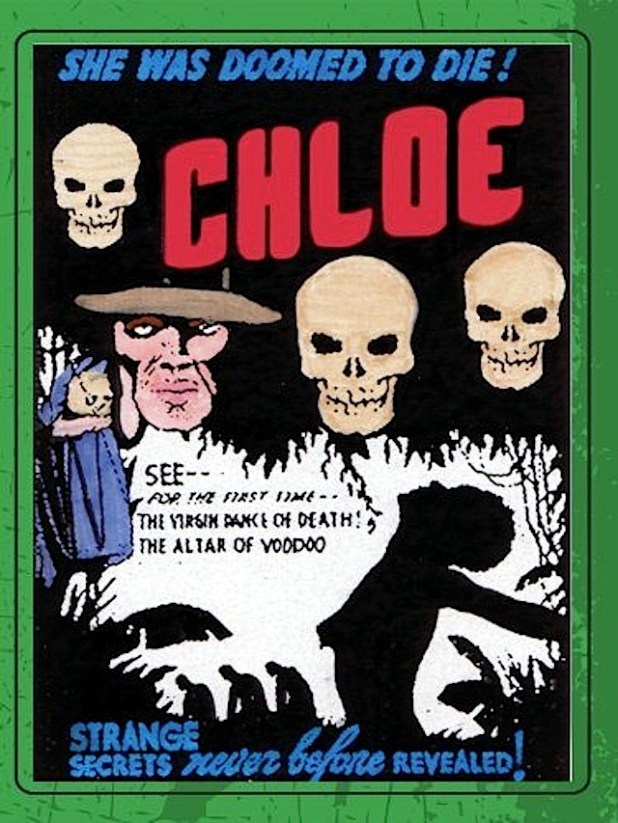
Chloe (Olive Borden) has escaped the swamps where she was raised and her family, including her mother Mandy (Georgette Harvey). Thanks to the light color of her skin, she’s passed for a white person. She’s in love with Wade (Reed Howes), who works for Colonel Gordon (Francis Joyner). The problem comes when her mother keeps bringing up — the swamps aren’t all that far — that Gordon led the lynch mob who hung her father.

This all leads to the wild truth that Chloe is really Gordon’s daughter and that he never ordered Sam’s death. Mandy takes her into the swamps and is ready to kill her as part of a voodoo ritual when she’s saved by Wade, who is really saved by Jim (Phillip Ober), a black man in love with Chloe, so romantically driven that he fights an alligator for her and then dies to save both her and her white man. Because Chloe is really white and man, this movie is really racist. It’s a tale of a black girl who hopes and dreams that she is white, that wish comes true and then her black mom tries to kill her while a black man sacrifices his life to save her and a white man. Then, she moves into a mansion.

The voodoo scenes look really scary, however.

Chloe was one of three films — along with Hired Wife and Playthings of Desire — that were made at Sun Haven Studios in St. Petersburg, Florida. The goal was to take back Florida as a filmmaking destination from Hollywood.

You can watch this on Tubi.

MILL CREEK SCI-FI CLASSICS: The Lost Jungle (1934)

There was a serial and movie of this released at the same time. They filmed several principal scenes with different dialog along with a new ending to make two totally different films. It’s also sort of a sequel to another serial, Darkest Africa.

This stars Clyde Beatty, who was one of the most famous circus performers and animal trainers in the world. He got into the business by hitching a ride on a train and joining Howe’s Great London and Van Amburgh’s Wild Animal Circus. His greatest shows had him in a cage alone with 43 lions at the same time. His wife Harriett Evans and his daughter Albnina were both animal trainers.

Directed by David Howard (Mystery Ranch) and Armand Schaefer (who went into producing when TV came around), who wrote the story with Wyndham Gittens and Barney A. Sarecky, this has Clyde looking for his lady Ruth (Cecilia Parker) in the jungle. He even crashes a zeppelin to get out there! Every animal is real except for the guy in the ape suit.

UNSUNG HORRORS HORROR GIVES BACK 2023: El fantasma del convento (1934)

Each October, the Unsung Horrors podcast does a month of themed movies. This year they will once again be setting up a fundraiser to benefit Best Friends, which is working to save the lives of cats and dogs all across America, giving pets second chances and happy homes.

Today’s theme: Mexico

The Ghost of the Convent (released in the U.S. as The Phantom of the Convent) starts with sin: Cristina (Marta Roel), the wife of Eduardo (Carlos Villatoro), decides to try to lure Alfonso (Enrique del Campo) into her arms as they explore a forest together. However, a mysterious stranger guides them to an abandoned monastery.

Father Superior (Paco Martinez) reveals to them that one of the monks tried to seduce a friend’s wife once. Even in death, the monk couldn’t find peace and he remains today, a fact that Alfonos sees for himself. Imagine how he feels, ready to take his friend’s wife, and he sees the mummified monk, a book filled with blood and the body of Eduardo.

But is it all a dream? All three wake up at the holy place, which is now a tourist attraction.

Director Fernando de Fuentes was mainly known for his Revolution Trilogy — El prisionero trece, El compadre Mendoza and Vámonos con Pancho Villa — and was a pioneer in filmmaking. He also contributed to the script by Juan Bastillo Oro and Jorge Pezet.

The monastery says “When the soil harbors no impure desire, there is nothing to fear in the house of God.” Yet this trio is pulled in and may not be able to leave and they aren’t the only group of people pulled into this shadow world where ghostly monks repeat the same actions eternally and the sinful monk wails in his cell forever. This film also takes its time, yet it demand watching, as its spectral fingers are intertwined in so much of the horror that we love all these decades after.

You can watch this on YouTube.

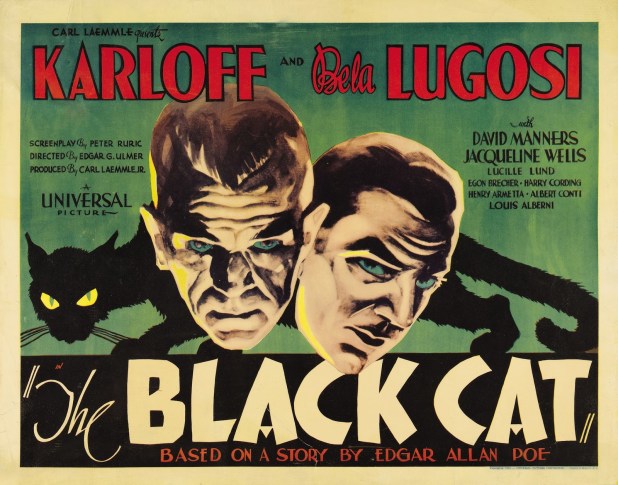
APRIL MOVIE THON DAY 11: The Black Cat (1934)

The first of eight films to pair Bela Lugosi and Boris Karloff, this has so much less to do with the Edgar Allan Poe story and so much more to do with Aleister Crowley, in particular a series of rituals and did with Betty May Loveday.

Loveday was a model, a dancer, an artist and the lover of White Panther, a member of L’Apache Gang, and a fight over him led to her nickname: The Tiger Woman. She once said, “I have not cared what the world thought of me and as a result what it thought has often not been very kind. I have often lived only for pleasure and excitement.”

After marrying Miles Linzee Atkinson — who had access to cocaine as he was a doctor — they both became addicts, a habit she kept into her second marriage.

In 1922, her third husband Frederick Charles Loveday became an acolyte of Aleister Crowley, who considered Loveday his magical heir but condemned his marriage. In her book Tiger Woman, Loveday claimed she found a chest containing men’s ties which were covered with dried blood. Crowley told her they belonged to Jack the Ripper, who he knew, who was still alive and who had been a surgeon and magician who taught him how to become invisible.

Frederick — who also used the name Raoul — was never a healthy person. In her book, Betty May said that Crowley recommended that he drink a cat’s blood. Regardless of the truth of that story, he did drink water from a stream that Crowley had warned him about and he died in 1923.

The entire time May was in Italy with her husband and Crowley, she had been May had been sending reports to the Sunday Express informing the public of what Crowley was up to. Those rituals that she describes appear in The Black Cat. When she returned to England, she sold the rest of her story to the Sunday Express and John Bull, which is where Crowley’s title The Wickedest Man in the World” comes from.

She also mentions that after the death of her husband, she tried to kill Crowley by firing a gun directly at Crowley’s head at point-blank range and missing. He laughed and she shot again. The gun jammed.

Betty May was the principal witness in the suit brought by Aleister Crowley against Nina Hamnett for libel in her book Laughing Torso which led to someone stealing her letters of proof, more libel suits and Crowley being “bound” by the court for two years.

Anyhow…

Peter (David Manners) and Joan Alison (Julie Bishop) are on a train en route to on their honeymoon in Hungary, during which they share a car with psychiatrist Dr. Vitus Werdegast (Lugosi), a Hungarian psychiatrist who spent the last 15 years as a prisoner a Siberian prison camp. Now, he is traveling to visit Hjalmar Poelzig (Karloff), an Austrian architect.

Somehow, all three end up on a bus which crashes near Poelzig’s home. The foreboding estate sits upon the ruins of Fort Marmorus, which Poelzig commanded during the war. It also turns out that the doctor and architect are not great friends, as Werdegast accuses Poelzig of betraying their side to the Russians, leading to thousands of deaths, as well as stealing his wife Karen and killing his black cat. He might be correct, as Werdegast literally has a collection of dead women on display and Karen is one of them.

Poelzig is quite literally the devil on earth, as he has taken Werdegast’s daughter as his new wife and planning on killing Peter and sacrificing June. Seriously, I don’t want to give away the end of this movie away and I’m amazed that pre-code horror is so grisly and outright filled with darkness. This wasn’t a small independent movie. This was Universal’s biggest movie of 1934.

Poelzig’s chant doesn’t coming from Crowley and is invented Latin nonsense. Thanks to IMDB trivia, it translates as “With a grain of salt. A brave man may fall, but he cannot yield. To err is human. The wolf may change his skin, but not his nature. Truth is mighty, and will prevail. External actions show internal secrets. Remember when life’s path is steep to keep your mind even. The loss that is not known is no loss at all. Heavy thunder. With a grain of salt. A brave man may fall, but he cannot yield. By fruit, not by leaves, judge a tree. Every madman thinks everybody mad. Who repents from sinning is almost innocent.”

Despite this being such a big movie, Edgar G. Ulmer’s career didn’t take off. That’s because he began an affair with Shirley Castle, who would eventually become his wife. At the time, she was married to Max Alexander, a producer at Universal Pictures and nephew of Universal chief Carl Laemmle, who did not look kindly on “outsiders” upsetting his family. The scandal resulted in Ulmer being blackballed from all of the major Hollywood studios for the rest of his career, so he worked on smaller movies about which Peter Bogdonavich wrote “the astonishing thing is that so many of Ulmer’s movies have a clearly identifiable signature despite being accomplished with so little encouragement and so few means.”

He found a home at PRC, the lowest of the low that was Hollywood’s “Poverty Row” studios, but Shirley stayed by his side, acting as the script supervisor on nearly all of his films as well as writing several of the screenplays. Their daughter Arianne appeared as an extra in his movies. If you’d like to check them out, some of his post-Black Cat films include The Amazing Transparent ManStrange Illusion and The Man from Planet X.
KINO LORBER BLU RAY RELEASE: Double Door (1934)

Based on the 1933 Broadway play of the same name by Elizabeth A. McFadden, Double Door is a pre-Hays Code directed by Charles Vidor (GildaBlind Alley).

Victoria Van Brett (Mary Morris, who had a long stage career but this was her only film) rules her family, even destroying the relationships that her brother Rip (Kent Taylor, Brain of Blood many years after this) has until Anne Darrow (Evelyn Venable, the voice and the model for the Blue Fairy in Pinocchio and one of the rumored inspirations for the Columbia Pictures logo) starts dating him. Just how horrible is Victoria? Well, she once locked her sister Caroline (Anne Revere, who would win the Best Supporting Oscar for National Velvet and be an outspoken critic of the House Un-American Activities Committee, which got her blacklisted) in a soundproof safe for a long period of time just for making her mad.

I mean, she also has one of the servants close the organ during “Here Comes the Bride” as Victoria and Rip are being married in her house, so there’s really no limit to the amount of mean that she has in store for everyone. That must be how she got the name “The Female Frankenstein of Fifth Avenue.”

Double Door has just been re-released by Kino Lorber, along with two audio commentaries. One is by Tom Weaver and the other by David Del Valle and Stan Shaffer. There are also trailers and subtitles. You can order it directly from Kino Lorber.

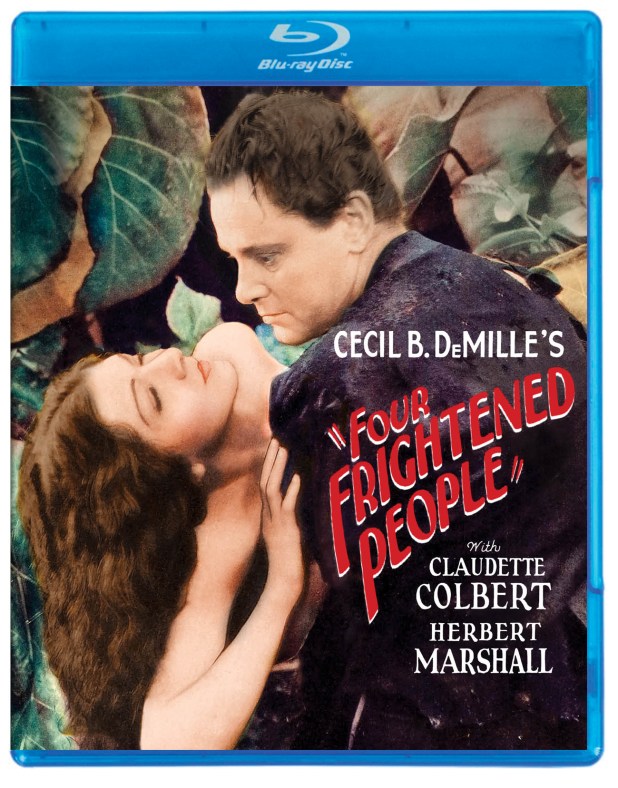
Four Frightened People (1934)

Arnold Ainger (Herbert Marshall, who lost a leg during World War I yet became one of the biggest leading men of Hollywood; he was also the star of the radio drama The Man Called X), Mrs. Mardick (Mary Boland, The Women), Stewart Corder (William Gargan, who played radio and TV detective Martin Kane) and Judy Jones (Claudette Colbert, It Happened One Night) have escaped their bubonic plague-infested ship and ended up on a jungle island populated with primitive natives and wild beasts.

The print ad for this had great copy: “Once…ladies and gentleman…the last remnants of civilization slipped from them with their tattered clothes…Now they were male and female battling the jungle for life…each other for love!”

This is a movie that doesn’t get mentioned in the films of Cecil B. DeMille all that often. This movie looks great, despite being shot on location in Hawaii. Also, while Colbert used a stand-in wearing a flesh-colored bodysuit for the waterfall scene, she was nearly nude in other moments. This was, of course, before the Hayes Code.

The new Kino Lorber blu ray release of this movie features audio commentary by Nick Pinkerton and the original trailer.

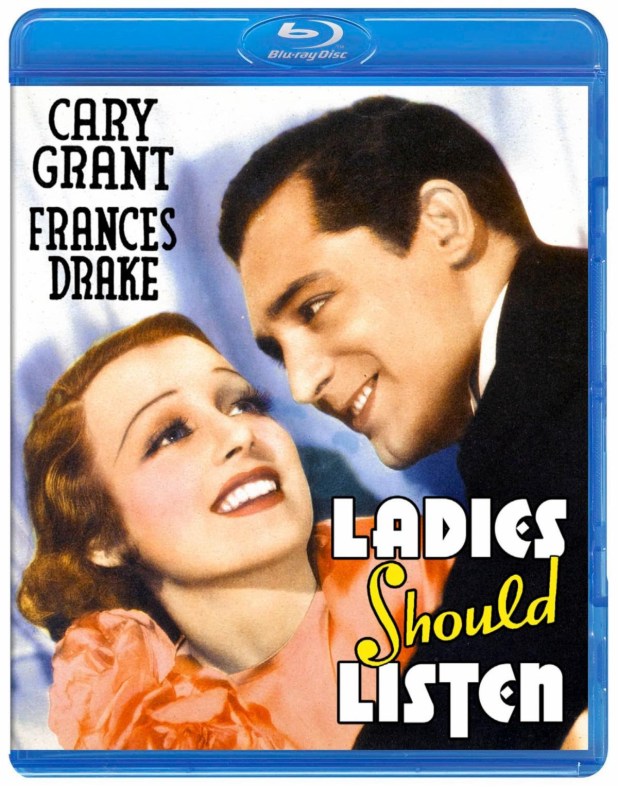
Ladies Should Listen (1934)

Directed by Frank Tuttle (A Cry In the Night) and starring Cary Grant, this romantic comedy is all about switchboard operator Anna Mirelle (Frances Drake, Les Misérables) who falls in love with Grant’s character of Julian De Lussac, a man she has only met over the phone. To win him over, she’ll have to break him up with his current love, Marguerite (Rosita Moreno, The House of a Thousand Candles), which is actually a good thing, as she’s already married to Ramon Cintos (Rafael Corio) and the two of them are about to swindle him out of a nitrate mine.

Meanwhile, Julian’s best friend Paul Vernet (Edward Everett Horton, the narrator of Fractured Fairy Tales) is growing mad at him because he’s lost the eye of millionaire heiress Susie Flamberg ( Nydia Westman, who was in two Bulldog Drummond movies).

If this feels like a stage play, that’s because it was based on one by Alfred Savoir and Guy Bolton. The screenplay was by Claude Binyon and Frank Butler.

You can get this as part of Kino Lorber’s Cary Grant Collection, which is a great opportunity to own some of the actor’s earliest films on blu ray.

PURE TERROR MONTH: Green Eyes (1934)

Oh PURE TERROR, you box set of my dreams. Sometimes, you reward me with Italian cyborgs. Or then a movie about jungle cannibals. Or this — whatever Green Eyes is, a Chesterfield Pictures movie made before the Hayes Code. Who at Mill Creek decides what goes into these box sets?

During a masquarade ball, Stephen Kester (Claude Gillingwater, whose injury on the set of Florida Special and the premature death of his wife led to an early suicide) is found stabbed three times in the closet of his room. It could be anyone that killed him, but it’s probably his granddaughter Jean (Shirley Grey, whose acting career ended in 1935) and her fiancee Cliff Miller (William Bakewell, whose acting life went from the 1920’s to the 1970’s). After all, they ran from the scene of the crime, but not before they killed the phones and ruined all the cars.

Inspector Crofton (John Wray, he played the farmer who tries to kill Gary Cooper in Mr. Deeds Goes To Town) and Detective Regan are in the case, as well as a mystery writer named Bill Tracy (Charles Starrett, The Durango Kid!).

Green Eyes was directed by Richard Thorpe, who is more well-known for the movie he didn’t direct than the hundreds he did.

Thorpe was the original director of The Wizard of Oz, but got fired within two weeks, as it was believed that he didn’t understand the fantasy elements of the story. He also gave Judy Garland a blonde wig and baby doll make-up that made her look anything like an innocent farm girl. The only footage from his directing that remains is when Toto runs from the Wicked Witch’s castle.

He also directed Jailhouse Rock with Elvis, Above Suspicion with Joan Crawford and several of the Tarzan films.

If you don’t have the PURE TERROR set, you can watch this for free on Amazon Prime and the Internet Archive.