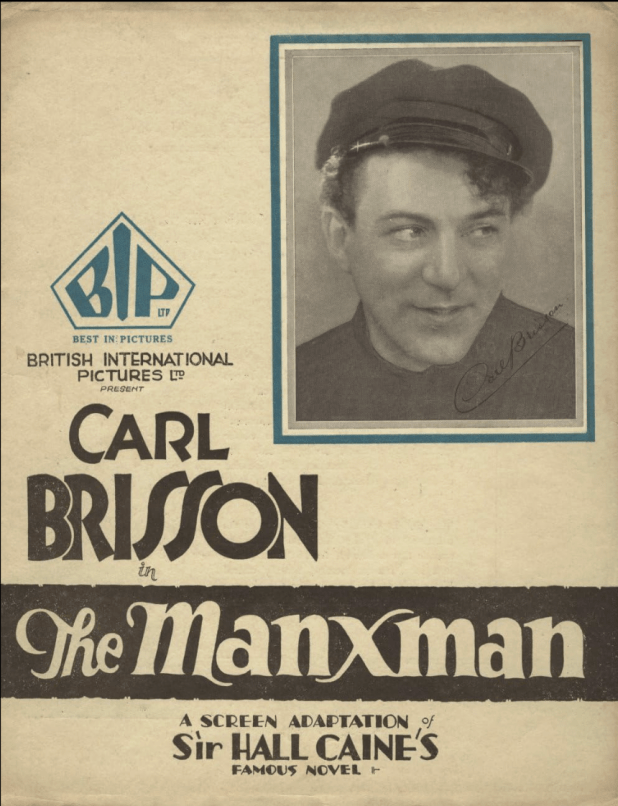
Alfred Hitchcock’s last silent film, The Manxman, is about fisherman Pete Quilliam (Carl Brisson and lawyer Philip Christian (Malcolm Keen), friends from birth, but both after the same woman: Kate (Anny Ondra). Pete asks Phillip to ask her father, Caesar Cregeen (Randle Ayrton), for permission to marry. He says no, as Pete is poor. He goes to Africa to make his fortune, leaving his friend behind to watch over Kate.
As you can figure out, Phillip and Kate fall in love. Pete is said to have died in Africa, so they plan on being together, just in time for him to come home and marry her. But ah, one day at the Old Mill, they made love, so the baby she gave birth to doesn’t belong to her husband. It’s the child of the top judge in town, Phillip.
This movie was to be filmed on the Isle of Man, but Hitchcock eventually relocated production to Cornwall due to frequent creative interference from author Hall Caine. However, Caine was invited to Elstree Studios to observe. As for Carl Brisson, he got to play two cheated husbands for Hitchcock, in this movie and in The Ring.
18. THE EYES HAVE IT: Elect to watch one with an eye specific scene. See what I did there?
Luis Buñuel pretty much invented cinematic surrealism. He said that when he filmed, he knew “exactly how each scene will be shot and what the final montage will be.” From this film to The Exterminating Angel, Belle de jour and Tristana and so many more, his influence as a filmmaker is incalculable.
Just as dominant is his co-writer, Salvador Dali, whose is synonymous with surrealism. In fact, when he needed a dream sequence for Spellbound, Alfred Hitchcock allowed Dali to direct it. Of course, it was cut, but that’s how well-regarded he was.
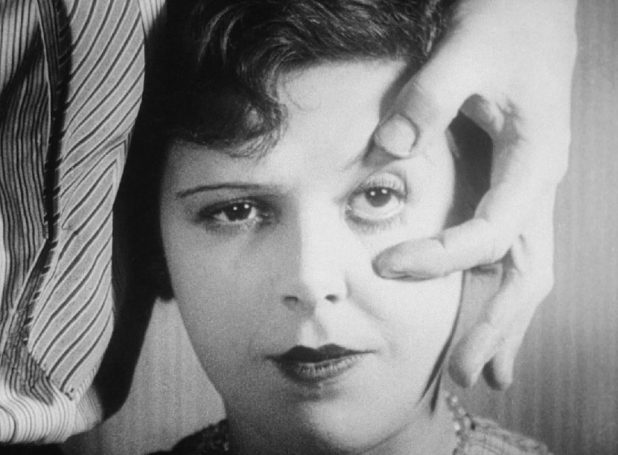
Words like dream logic weren’t used yet but this is it. It begins with a woman having her eyeball sliced open, then the screen says, “Eight years later,” just in time for a boy in a nun’s habit to crash outside her home, lose his hand and appear in her the eyeless woman’s apartment as ants walk out of a hole in his hand.
That same man watches with pleasure as a woman takes that hand before being hit by a car before trying to assault the woman, then dragging around two grand pianos, several dead donkeys and the Ten Commandments.
Time keeps changing, whether it’s around three in the morning or sixteen years ago or in spring. This is all a dream of its creators, starting with Buñuel telling Dali that he had a vision of a cloud going across the moon, “like a razor blade slicing through an eye.” Dali said, “There’s the film, let’s go and make it.”
There was one rule: Do not dwell on what required purely rational, psychological or cultural explanations. Open the way to the irrational. It was accepted only that which struck us, regardless of the meaning. Buñuel also said, “Nothing, in the film, symbolizes anything. The only method of investigation of the symbols would be, perhaps, psychoanalysis.”
When this debuted at the Studio des Ursulines, Pablo Picasso, Le Corbusier, Jean Cocteau, Christian Bérard, Georges Auric and André Breton’s Surrealist group were in the audience watching. Buñuel had rocks in his pockets in case there was a riot. He had wanted to insult the intellectuals with this, saying, “What can I do about the people who adore all that is new, even when it goes against their deepest convictions, or about the insincere, corrupt press, and the inane herd that saw beauty or poetry in something which was basically no more than a desperate impassioned call for murder?”
There’s an urban legend that two women miscarried while watching this. Maybe it was the eyeball — a calf’s eye — or maybe Buñuel and Dali also invented being William Castle.
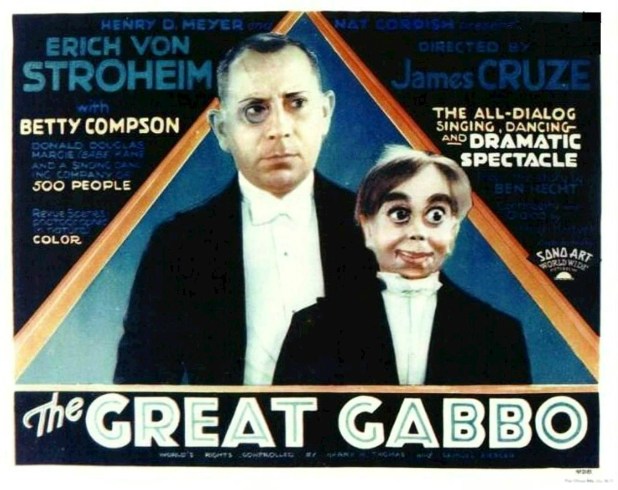
Based on “The Rival Dummy” by Ben Hecht, The Great Gaboo was released as an “all-dialog singing, dancing and dramatic spectacle” with huge musical numbers that stand in stark contrast to the plot and often stop the film’s pace cold. There was even a scene shot in color, “The Ga Ga Bird”, which is missing from nearly all prints of the movie today. The musical sequences are so big — “Web of Love” was used for years in other films and dance sequences was re-used with different music in 1932’s The Girl from Calgary — that you may forget that this is kind of a horror movie.
Predating Dead of Night, The Twilight Zone episodes “The Dummy” and “Caesar and Me,” Magic, Devil Doll and even The Simpsons episode “Krusty Gets Kancelled,” this is the tale of an artist — ventriloquist Gabbo (Erich von Stroheim, who in addition to being an actor — known as “the man you love to hate” — was also one of the first auteur directors, beloved by Surrealists and a man banned from Hollywood — he was unwilling to compromise his art for commercial cinema, while also being obsessed with the finest of details and more than willing to spend as much money as possible on his films despite scenes that were too shocking to ever be shown; yeah this is a run-on sentence but he’s a personal hero) — who only speaks through his dummy Otto*.
Gabbo is amazing — he can make Otto talk and sing while he smokes, drinks and eats, which wows audiences — but he’s a complete maniac who can only relate to the outside world through the dummy. His girlfriend and assistant Mary (Betty Compson) leaves him after years of suffering through his tics and complete hatred of the world.
Two years pass and Gabbo has become a star while Mary has moved on to a relationship with a dancer. The Gabbo she meets now is a complete man, one who relates to her with thought and romance. He confesses that without her, he realized his failings and worked to improve himself. She tells him that she is now married and they cannot be together, saying goodbye to Otto and not him. His life ruined, he explodes, punching the doll in the face before holding it, taking Otto to the stage where he ruins the show and loses his career.
Director James Cruze acted in, directed and or produced over 100 films in the silent era. Not much is known about his life before Hollywood as he told a different story to every interviewer. However, he sadly never was able to make the move from silents to talkies and after moving to work in Poverty Row studios like Republic, he killed himself in 1942.
I can’t imagine how audiences reacted to this. It really is a horror film, with a deranged protagonist who can’t relate to humanity that wants to desperately retain the two people who keep him sane — a woman in love with another man and his partner who is not even real. And then the music numbers! I love this movie for every odd thing it throws at me.
Newly restored by the Library of Congress — public domain versions have been out for years in much worse quality — The Great Gaboo is now available on blu ray from Kino Lorber.
*Otto was hand-carved by Frank Marshall, the same artist who made Edgar Bergen’s dummies.
 B&S About Movies
You must be logged in to post a comment.