MILL CREEK LEGENDS OF HORROR: The Lodger (1927)

Based on The Lodger by Marie Belloc Lowndes and the play Who Is He?, which was co-written by Belloc Lowndes, Hitchcock’s third movie was his first thriller and also the start of his cameo appearances. 

A killer named the Avenger has already murdered seven young blondes, always on Tuesday nights. Daisy Bunting (June Tripp), a model, has taken to hiding her hair color, as many other women do. Maybe her cop boyfriend Joe (Malcolm Keen) can keep her safe.

Daisy’s parents (Marie Ault and Arthur Chesney) keep a room at the top of their home and rent it out. The new lodger, Jonathan Drew (Ivor Novello), demands they remove all the photos of young blondes. You would think that this would scare Daisy, but you know how bad boys turn on good girls. Soon, she’s dating the lodger and has left Joe behind; Joe’s convinced she’s dating a killer and even tries to arrest him. 

There’s a reason: the lodger has a photo of the first victim and maps of each murder. Initially, this was supposed to end with a question about whether he really was the killer; the studio wouldn’t let that happen.

For the beginning of the film, Hitchcock wanted to show the Avenger’s murder victim being dragged out of the River Thames. Scotland Yard refused but said they would “look the other way” if he could do the filming in one night. It wasn’t to be. Hitchcock learned that his cameraman had forgotten to put the lens on the camera before filming the scene. It was replaced with a scene where the victim faces the camera and screams. She was lying on a sheet of glass, lit from underneath with the camera mounted on its side and the footage shot downward. An amazing piece of in-camera effects.

You can watch this on YouTube.
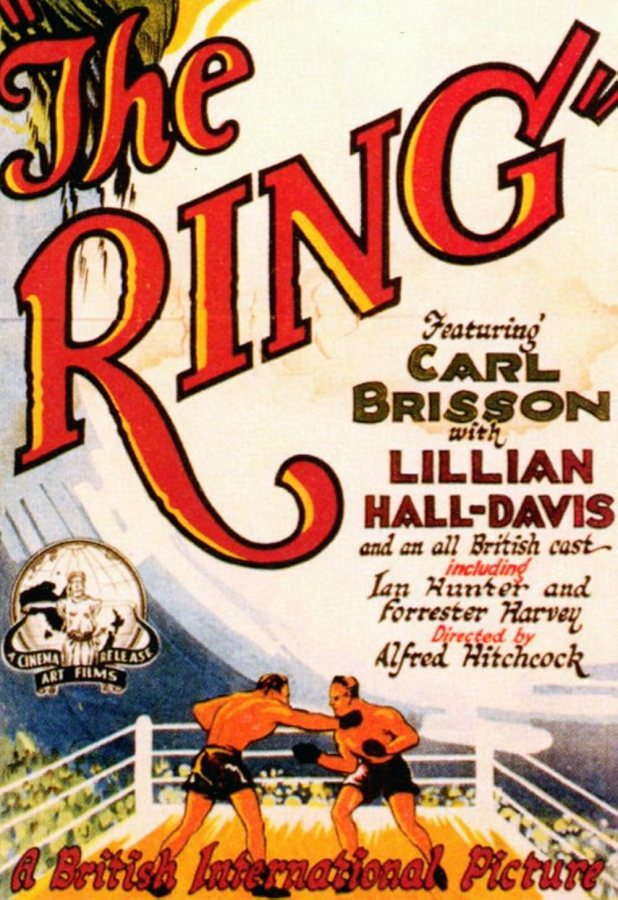
MILL CREEK LEGENDS OF HORROR: The Ring (1927)

“One Round” Jack Sander (Carl Brisson) is defeated by Australian heavyweight champion Bob Corby (Ian Hunter), whose manager offers to have Jack be Bob’s full-time sparring partner. But oh, Bob— he’s all over Jack’s girlfriend, Mabel (Lillian Hall-Davis), buying her a bracelet and canoodling with her. On their wedding day, Jack starts to believe that Bob is trying to steal his wife. He’s right, so he trains hard to be in contention for the title, wanting to take away the only thing that matters more to boxers than their women. You know how it ends? Mabel decides to leave Bob for Jack, giving him the power in their fight to knock out his former friend.

Yes, Alfred Hitchcock directed and wrote a boxing movie. At the age of 28, this was only his fourth movie, yet he was already demonstrating his unique storytelling skills. Despite his young age, Hitchcock used advanced camera tricks, like the Schüfftan process, to simulate a large audience for the Royal Albert Hall final fight, a technique he would later use in ‘ The Man Who Knew Too Much. The Ring is also significant as Hitchcock’s only “original” film, one not based on a play or book with no other published writers collaborating. 

It may also be the first movie where someone gives the finger.

You can watch this on Tubi.

Sensation Seekers (1927)

According to film historian Anthony Slide, Florence Lois Weber “was the American cinema’s first genuine auteur, a filmmaker involved in all aspects of production and one who utilized the motion picture to put across her own ideas and philosophies.” She’s also been called the most important female director in the history of American film. It’s amazing that she was making movies in a time when women were still battling for the right to vote.

This is the story of a small town girl turned Long Island jazz baby Egypt Hagen (Billie Dove) who can’t be tamed, not even by the minister who seeks to save her. The dancing scenes are filled with passion matched only by the spectacle close of a shipwreck.

Kino Lorber has released Sensation Seekers and A Chapter In Her Life on blu ray, with 2K restorations by Universal Pictures and commentary on this film by Shelley Stamp, who wrote Lois Weber in Early Hollywood.

This is a recommended purchase, as its an opportunity to see the start of Hollywood and learn the story of an important female artist whose story has not been told nearly enough.