15. GOES WITHOUT SAYING: Feast your eyes on something with little to no dialogue at all.
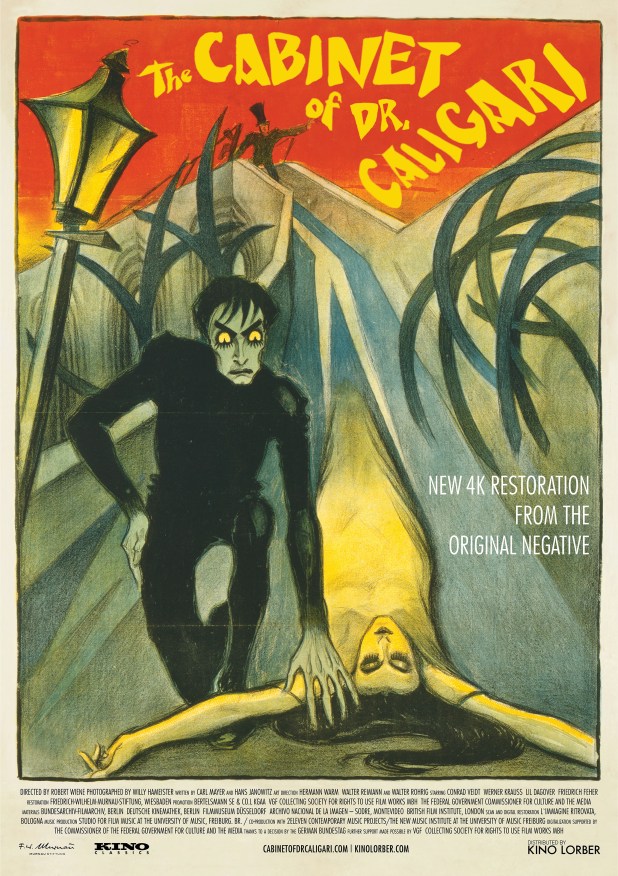
Directed by Robert Wiene and written by Hans Janowitz and Carl Mayer, this is the perfect expression of German Expressionism. Janowitz and Mayer, both pacifists who despised authority after their military experiences during World War I, created something amazing here, which Wiene realized.
Roger Ebert called it arguably “the first true horror film,” and it’s still unsettling to watch today.
Dr. Caligari (Werner Krauss) is a hypnotist who has his own sleeping man, Cesare (Conrad Veidt), whom he uses to entertain — and murder — people. Caligari prophesies that Franzis’ (Friedrich Feher) best friend Alan (Hans Heinrich von Twardowski) will die by morning. When it happens, Franzis and his girlfriend Jane (Lil Dagover) investigate, which leads to a plot where Caligari may or may not be the head doctor of an asylum.
But ah, the ending! The beginning seems so simple, with Franzis telling his story. Finding out that he’s an unreliable narrator makes this entire movie one to watch again.
Is this a fairy tale? Is it one man trying to make sense of things? Is it Janowitz working out witnessing a murder behind the Holstenwall, which gives the setting its name?
While this is considered a cult movie, it was released as a typical film. But when we see it today, a hundred years later, we think that it had to have been an art film.
Every time Beth (Lyndsey Craine) dies — at her own hand — she wakes up in another horror movie. This time, it’s a cannibal romantic comedy. And that idea, that Beth wants to die but might learn something from each new film, is a great one. It doesn’t come back into this film at all, which is the first of the misfires that this movie commits.
My enthusiasm for this diminished somewhat when a Troma logo came across the screen. As for the story, well, Beth is the only student at Henenlotter High School — get it? — sees how horrible everything is and tries to do something about. The film seems to nudge you, wink wink you throughout; the same school is also the setting of director Liam Regan’s My Bloody Banjo. Those students not in the know can win the “All You Can Eat Massacre” contest and get a handgun of their own with which they can either shoot their fellow students or kill themselves.
Yet there may be hope. Beth has a crush on English teacher Miss Campbell (Lala Barlow) which seems to play out as a need to consume human flesh. This is the exact opposite of her vegan ethos yet eating one’s enemies is such sweet revenge.
The rest of the film uses teen movie stereotypes from Heathers, Tragedy Girls and Mean Girls to tell its tale of girl cliques and male sexual predators. Of all the imagery and ideas this movie uses, I liked that one of the female bullies favors Road Warrior Hawk makeup.
The movie — well, the evil teacher Nancy Applegate (Annabella Rich) — refers to Beth as “the millennial product of the American high school trope” and that would be an intriguing meta comment were it not so on the nose. Sure, her mother is dead, she has a horrible stepfather and school sucks, but why does she want to end her existence beyond a “woe is me” attitude? Far be it from me to expect good taste in film, much like exploitation, but I demand a character who has a reason, that a character with it is dying.
If she wants to live in a movie life that isn’t nostalgic horror, why does she play into the same cliches throughout? That motivation is never truly explored. Instead, there are endless references to other movies — if this were a Marvel comic, there’d be an editor note in every panel, cluttering this up with reference upon reference — and can you top this gross-out humor. Trust me, I love humor like that. Lloyd Kaufmann saying “Alex Baldwin” and blowing out his brains is anything but wit.
To be satire, one must have some position from which to state why something is worthy of ridicule, lest it becomes precisely what it is deriding. If you want to make fun of direct-to-video horror, that’s not that hard. If you want to make a satire about hot button issues like date rape and teen suicide, go for it. But you better bring your best material. And if this is it, I am not interested in seeing what comes next.
If you do like Troma, you can get this from MVD. It comes with an audio commentary, a making-of, deleted scenes, outtakes, a gore reel, a raw b-roll, cast interviews, a VFX reel, trailers and an introduction from Lloyd Kaufman.
John Barrymore, who plays both Dr. Henry Jekyll and Mr. Edward Hyde in this movie, was such a gifted physical actor that the initial part of his transformation has no makeup. It’s him contorting his body and appearance all on his own.
This adaption of Strange Case of Dr. Jekyll and Mr. Hyde by Robert Louis Stevenson was written by Clara Beranger (who was one of the original faculty members at USC School of Cinematic Arts) and was directed by John S. Robertson, who The Byrds wrote the song “Old John Robertson” about.
Henry Jekyll (Barrymore) is led to believe that all men have two sides at constant war for their souls: a good and evil brain, basically. A potion that he creates allows him to access that evil side of his being, unleashing Edward Hyde. Yet by the end of the film, the potion is no longer needed and the transformation comes whenever Jekyll becomes upset.
A few years after making this movie, Barrymore bought a house in Hollywood for $6,000. He got the seller to lower the price by a thousand dollars by showing up the closing dressed as Mr. Hyde.
Genuine, die Tragödie eines seltsamen Hauses (Genuine, the Tragedy of a Strange House) was Robert Wiene’s follow-up to The Cabinet of Dr. Caligari, with writer Carl Mayer, cinematographer Willy Hameister and production designer Cesar Klein returned to work on this vampiric film.
Genuine is not a true vampire, but instead a succubus that drains the souls of men, even destroying the life of the man who has painted her as this movie begins. Before the movie ends, she will cause men to murder one another and drive others to nearly kill themselves with her charms.
Genuine was played by Fern Andra, an acrobat whose physical acting is incredible. She’s a mystery of a woman who destroys men simply because she enjoys doing so. At first a savage captured from a tribe and kept by a rich old man, she soon takes over the man’s home and earns the ire of everyone in the surrounding area.
Is Genuine real? Is she an idea? Is she art? Is the story in the film a dream? While Dr. Caligari was a success, this film was seen as too much art for art’s sake. I think even back in 1920, popular audiences could often be quite dumb.


 B&S About Movies
You must be logged in to post a comment.