In the rigid, Catholic-guilt-soaked landscape of late 60s Italy, a widow wasn’t supposed to do much besides wear black, weep over a portrait of her departed husband, and perhaps consult a priest about her loneliness. But Mimi (the ethereal, wide-eyed Catherine Spaak) isn’t interested in the script society wrote for her. When her husband, Franco, kicks the bucket, he leaves behind more than just a grieving widow; he leaves a secret high-tech bachelor pad equipped with a little black book, instead of sharing his fantasies with her, that he kept a lair where he could cheat on her.
Instead of burning the apartment down in a fit of rage, Mimi decides to use it as a laboratory. If Franco spent his life grading women on a scale of imagination, experience, talent and cooperation, why shouldn’t she do the same to the men of Italy?
Now, in the place where her husband sinned while striving to keep her pure, everything changes.
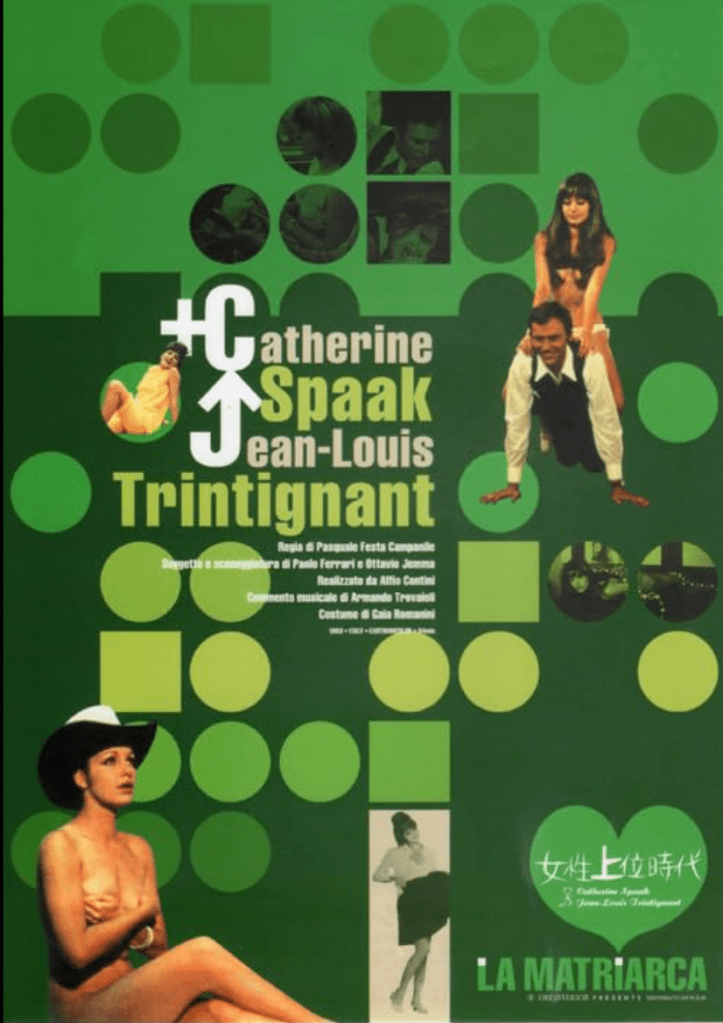
Directed by Pasquale Festa Campanile, best known for his commedia all’italiana like Il merlo maschio, When Women Had Tails and When Women Lost Their Tails, as well as the harrowing Hitch-Hike, this is about a woman going from an affection-negative marriage to finding love — or lust — everywhere.
Luckily, she finds the perfect partner in Dr. Carlo De Marchi (Jean-Louis Trintignant), a man who can match her kink for kink, but more importantly, wants to connect with her outside of the bedroom. Other conquests include Philippe Leroy as a tennis instructor who can’t get aroused when she’s the one who comes on to him; Italian Western tough guy Luigi Pistilli; Pistilli’s The Great Silence co-star Frank Wolff playing a dentist; Renzo Montagnani, who was Maluc in Campanile’s caveman nudie cuties and the man who would marry Black Emanuelle for real, Gabriele Tinti, playing a man who thinks Mimi is a prostitute. The biggest problem is that she instantly sleeps with her husband’s business partner, Sandro (Gigi Proietti), who claims her as his property and even refers to her as a whore, as mentioned above.
I love this movie because somehow, it came out in 1968 Italy and yet represented a step forward — not always, I get that there are still issues in this, but what do you expect from a male-made Italian sex comedy? — in the way Italian films, much less Italians, saw a woman owning her sexuality.
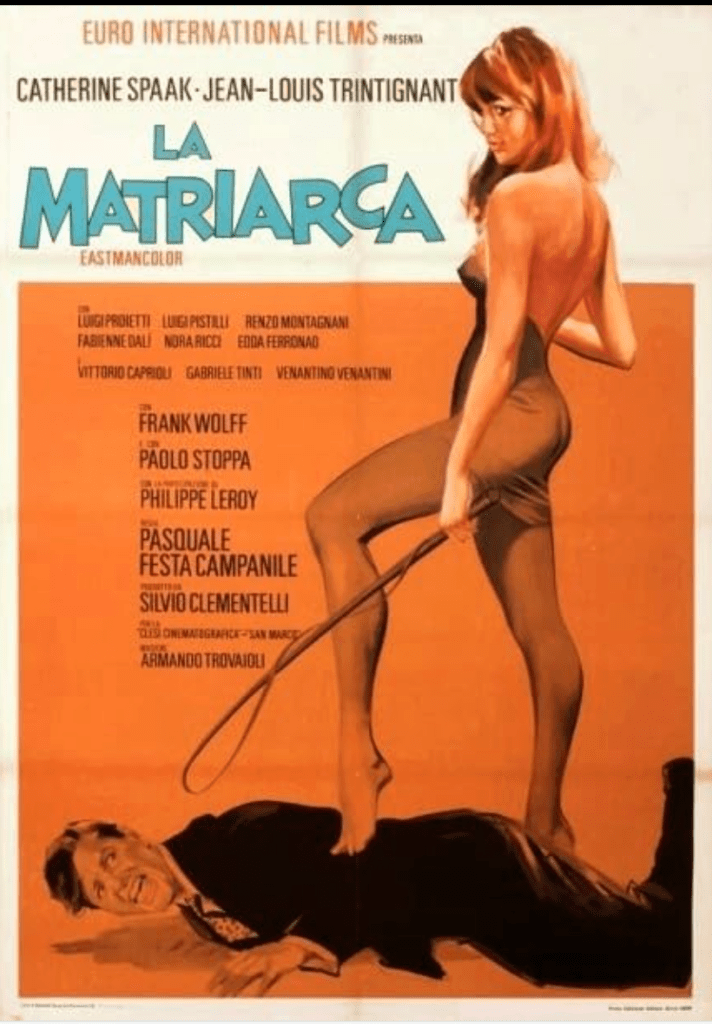
On Movie-Censorship.com, I found a line about this movie that I love: “Without drifting into the vulgar, she experiences various sexual styles until she discovers her favorite fetish in piggyback.” That’s why in Germany, this was called Huckepack (other amazing titles include The Aristotle Perversion; Sekso Manyak or Kadının İntikamı or Garip Duygular (Good Sex or The Woman’s Revenge or Strange Feelings in Turkish); Änka i trosor (Widow In Panties in Swedish); Una viuda desenfrenada (An Unbridled Widow in Russian, which is a nice play on the position and conceit of this film) or the best of all these titles, The Era of Female Dominence.
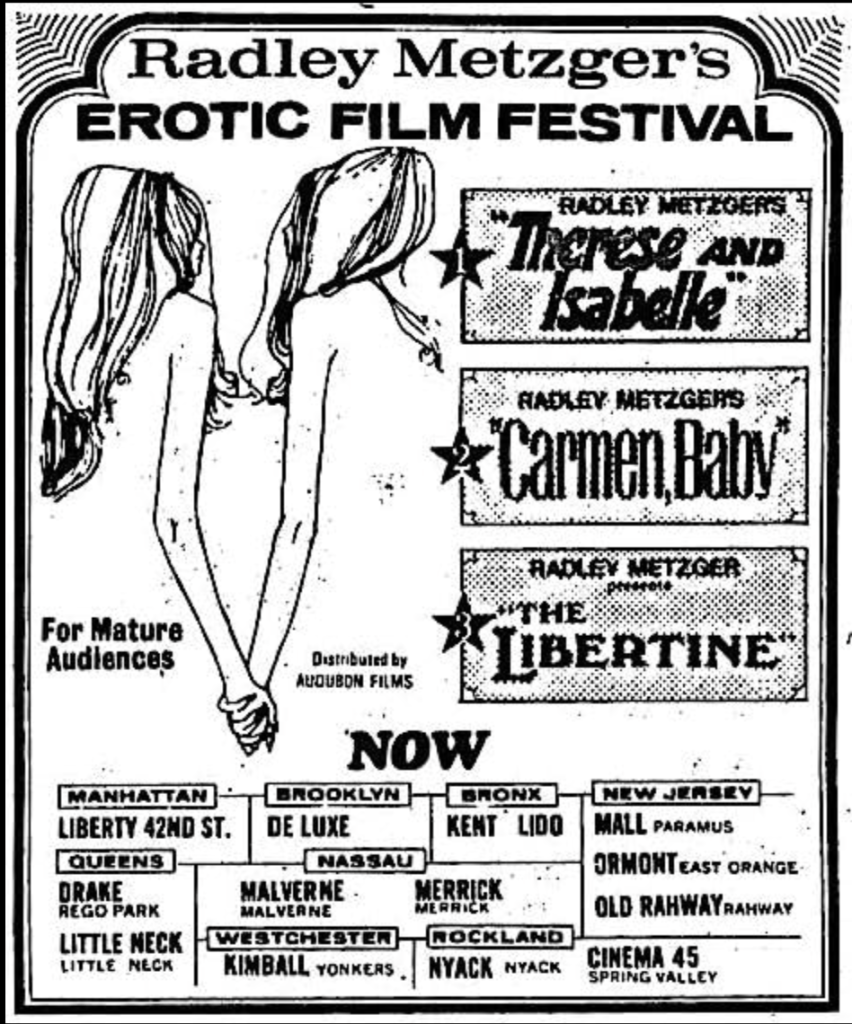
In its native Italy, this flick is La Matriarca. Think about that word. The Matriarch. It drips with the heavy, incense-laden weight of the Italian family unit. It suggests a woman taking the throne, perhaps with a rolling pin in one hand and a rosary in the other. But then, it hits the States. Audubon Films, owned by Radley Metzger, knew they had a movie with Spaak nude, a blonde Italian sex goddess with eyes that could melt a Cinecittà camera lens, so instead of making a statement, they went with The Libertine.
To the Italian audience, she’s a woman reclaiming her power within the structure of her life; to the US grindhouse and art-house crowd, she’s just another bad girl on a sexual odyssey. Italy gives us the status, and America gives us the sin. Actually, Italy gives us a lot of sin, but I digress.
Audubon Films also gave us way more nudity, mostly more of Fabienne Dali from Kill, Baby… Kill!
I don’t like that Dr. Carlo becomes such a jerk at the end of the movie, because I would much rather he came to Mimi on her terms and wasn’t so rude. There was no need to destroy the secret sex apartment, which is incredible and could only exist in Italian movies. That pad is a masterpiece of 60s Italian production design, a space where the rules of the outside world don’t apply.
 B&S About Movies