We often think that ninjas only started to exist in the 80s. Yet, in the early 60s, there was a craze in Japan because of the Shinobi no Mono books and these three movies. Written by Tomoyoshi Murayama, these stories were serialized in the Sunday edition of the newspaper Akahata from November of 1960 to May of 1962, with the name meaning “ninja.”
The novels are set during Japan’s Sengoku period and star Goemon Ishikawa, a famous outlaw hero who used his ninja skills to battle the samurai. While the real man and his son were boiled alive in public after their failed assassination attempt on the warlord Toyotomi Hideyoshi, the fictional version has become a Robin Hood-like character, a man with near-superhuman ninja powers at times.
Goemon had already been the subject of several pre-WWII Japanese films- Ishikawa Goemon Ichidaiki and Ishikawa Goemon no Hoji. Still, in the early 60s, when a thief protecting villagers against the rich and powerful would be a theme that resonated with the Japanese, he became a pop culture sensation.
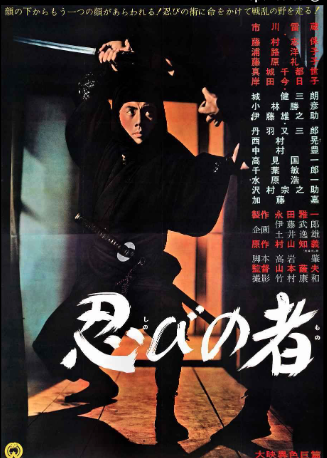
Band of Assassins (1962): Raizo Ichikawa plays Goemon as a young man here, a member of a ninja clan who must constantly worry about being found and destroyed by the samurai. He’s been selected to kill Nobunaga Oda (Tomisaburo Wakayama), which makes the other ninjas jealous. So now, Goemon is nearly a man without a country as he must deal with assassination attempts, double crosses and his mission.
Directed by Satsuo Yamamoto, this turned into the kind of movie that grabbed the attention of Japanese kids. It was intended to be one and done, but by the end, even though only Goemon survives and can escape this world of treachery and violence to have a family, he had to return. Ninjas, a real thing that had disappeared from the world- or is that what they want you to believe? — only to take over pop culture twice in the 20th century.

Revenge (1963): Nobunaga Oda has killed all of the ninjas of the Iga clan, yet he doesn’t know that Goemon has survived. Our hero just wants to build a family and disappear- ninjas are good at part of that- but he’s soon pulled back into combat when his infant son is killed.
Instead of running straight into the bad guys, as most action heroes would, Goemon uses psychological trickery and his ability to hide just about anywhere to drive his enemies crazy. Unlike the first film, where his honor is constantly on the line and he must watch everyone, his goals in this film are much more straightforward: kill the people who ruined his life.
Even though Goemon is boiled alive at the end of this- but not before shouting out the bad guys as way worse thieves than him- there’s still one more movie. How can that happen?
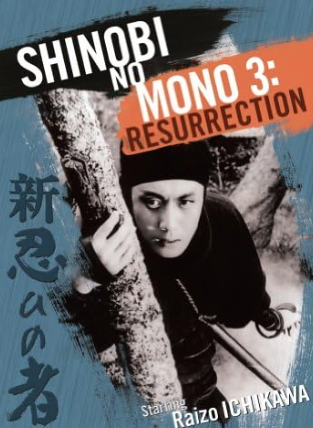
Resurrection (1963): Thanks to Hattori Hanzo (Saburô Date)- yes, the same man who made swords in Kill Bill– Goemon has survived, as he was switched out with another ninja at the last minute. I didn’t see it happen, but that’s just how talented a master ninja can be.
This idea was enough to get director Satsuo Yahamoto to quit the series, which brought in Kazuo Mori to make this for Daiei. It’s revisionist history- perhaps this is where Tarantino got the idea to save Sharon Tate- but in the service of pop culture and film commerce.
Now, he must get the revenge he’s craved for two movies now and take out Toyotomi Hideyoshi (Eijiro Tono). This is more personal and has less swordplay, but I’m sure audiences were ready for more, seeing as how all three of these movies were made over two years.

The Radiance Blu-ray box set of the Shinobi trilogy has digital transfers of each film presented on two discs, made available on Blu-ray for the first time outside Japan. Extras include an interview about director Satsuo Yamamoto with Shozo Ichiyama, artistic director of the Tokyo International Film Festival, a visual essay on the ninja in Japanese cinema by film scholar Mance Thompson, an interview with film critic Toshiaki Sato on star Raizo Ichikawa, trailers, six postcards of promotional material from the films, reversible sleeves featuring artwork based on original promotional materials and a limited edition booklet featuring new writing by Jonathan Clements on the Shinobi no mono series and Diane Wei Lewis on writer Tomoyoshi Murayama. This limited edition of 3000 copies is presented in a rigid box with full-height Scanavo cases and removable OBI strip, leaving packaging free of certificates and markings. You can get this from MVD.
 B&S About Movies
You must be logged in to post a comment.