ABOUT THE AUTHOR: Exploitation-film historian A.C. Nicholas, who has a sketchy background and hails from parts unknown in Western Pennsylvania, was once a drive-in theater projectionist and disk jockey. Currently, in addition to being a writer, editor, podcaster, and voice-over artist, he’s a regular guest co-host on the streaming Drive-In Asylum Double Feature and contributes to the Drive-In Asylum fanzine. His upcoming essay, “Of Punks and Stains and Student Films: A Tribute to Night Flight, the 80s Late-Night Cult Sensation,” will appear in Drive-In Asylum #26.
Valentine’s Day is here, and I’m going to enlighten—or annoy—you with 10 of my favorite romantic films. And because you know me, upbeat and happy-go-lucky, you know that the films are going to be dark and depressing. You won’t find When Harry Met Sally or Love Story on this list.
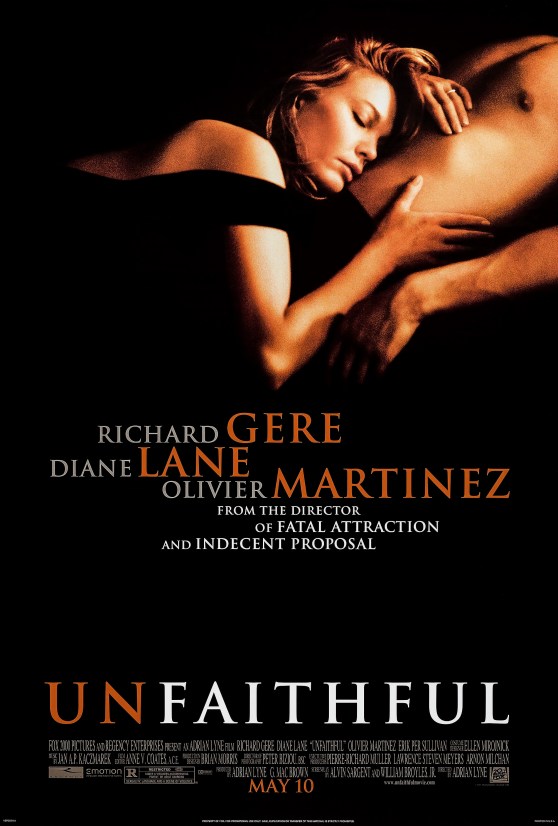
10. Unfaithful, starring Richard Gere and Diane Lane and directed by Adrian Lyne, who also did Fatal Attraction, Indecent Proposal, Flashdance, Jacob’s Ladder, and Nine ½ Weeks. That’s quite an eclectic filmography from an unpredictable director. Unfaithful is a remake of La Femme Infidele directed by Claude Chabrol, often called the French Hitchcock. I usually hate American remakes of great foreign films, but this one’s an exception. Diane Lane, always charming and wonderful, is married to Richard Gere. Yet, one day, she has a meet cute with a handsome stranger and impulsively has an affair. This has disastrous consequences. My wife thought that Lane’s cheating on Gere, who she noted is the perfect husband as he does the dishes, was inconceivable. It’s a fascinating film with Lane’s best performance; she got an Oscar nomination for Best Actress. One more thing about Diane Lane: If you watch her rom-coms—and she’s done a bunch—there are always two Diane Lanes. At the beginning of the film, her hair is up in a frumpy bun, and she’s sad. Later, when she falls in love, her hair is down. The Lane Rule: hair up, sad, no boyfriend; hair down, happily and passionately in love, a rule first noted by, I believe, the late critic Roger Ebert.
9. Leaving Las Vegas is a seriously depressing love story directed by the woefully underrated Mike Figgis with Nic Cage’s Oscar-winning turn as a depressed man who has come to Las Vegas to literally drink himself to death. He meets up with sex worker Elisabeth Shue, and they have a relationship of sorts. Will it be enough to save him? Don’t count on it.

8. Michael Mann is a world-class director of such lauded fare as The Insider, Ali, and Heat. His first film, Thief, was one of the best debut films of any director ever. James Caan, never better, plays a master thief fresh out of prison, who decides to start a new life, which includes having a family with waitress Tuesday Weld, also never better. But before that happens, he must do one last job for Robert Prosky, playing one of the most realistic, scariest mobsters ever. This job is, of course, going to cause problems for Caan and Weld. If you haven’t seen Thief, be prepared for a beautiful looking and sounding (courtesy the score by German electronic group Tangerine Dream) masterpiece from one of my favorite directors. Added plus: It has some lessons on how to crack safes … if you’re so inclined.

7. The Private Life of Sherlock Holmes. This Billy Wilder film, a big, expensive flop back in 1970, is a dark, yet moving, dramedy about a lost Sherlock Holmes case involving a woman’s missing husband, Queen Victoria, and the Loch Ness Monster. But central to the plot is a melancholy relationship between the misogynistic detective and a beautiful client, all punctuated by maestro Miklos Rozsa’s haunting violin concerto. Christopher Lee even shows up as Holmes’s brother Mycroft. Sad note: The studio, which was not high on the film, cut over an hour before release. This footage was lost and remains a grail quest for film buffs to this day.

6. Breathless, another remake of a French film, starring Richard Gere and directed by still another underrated director, Jim McBride. Gere plays a charming drifter who likes the music of Jerry Lee Lewis and Silver Surfer comic books. One night, he steals a car, shoots a cop, and decides to hook up with an old girlfriend. As the cliché goes, nothing good can come of this.
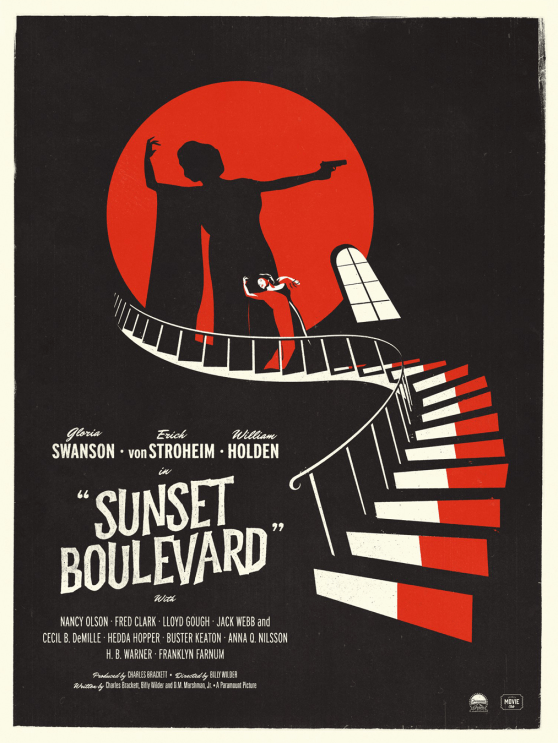
5. Sunset Boulevard. I had to include another film by Bill Wilder, the master of dark comedies (I could’ve also gone with Double Indemnity), and this one is on the National Film Registry of great American films. It’s narrated by William Holden, whom we first see lying face down in faded actress Gloria Swanson’s swimming pool. He tells the story of how he died. (I love movies that open in the middle of something, or as pretentious film scholars say, “in media res,” and then flash back to how we got there.) Phenomenal film.
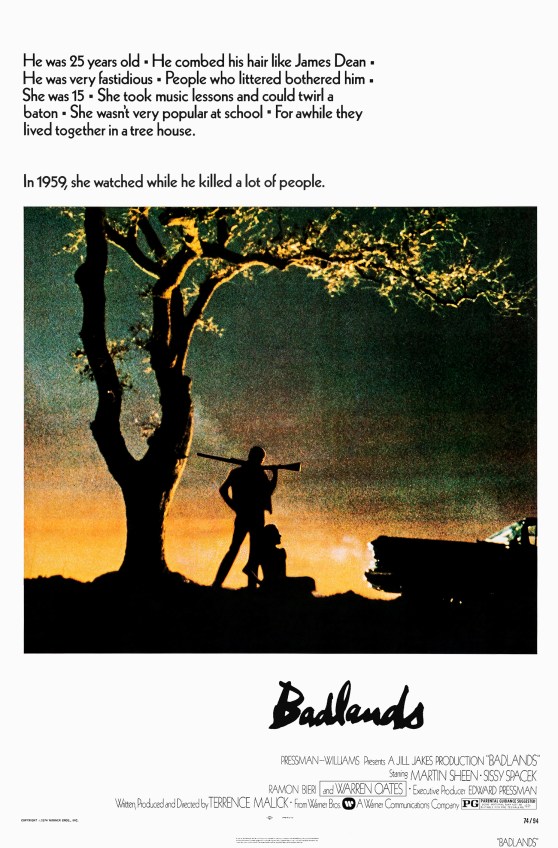
4. Badlands, Martin Sheen’s a killer, Sissy Spacek’s his teenage girlfriend, and they’re cutting a swath of violence across 1970s South Dakota. I was tempted to put Bonnie and Clyde, The Honeymoon Killers, or Natural Born Killers, also about criminals in love, in this spot, but I went with Terence Malick’s gorgeous, relatively unseen, downbeat masterpiece. A friend of mine watched it recently and thought it was too slow. I disagree. It’s a great film.

3. The Voices. Ryan Reynolds plays a nice guy who works in a warehouse and is looking for love from the likes of Anna Kendrick and Gemma Arterton. Complicating his life is that he’s schizophrenic, and he hears voices—his dog and cat talk to him. The dog, of course, is the voice of reason, while the cat tries to get him to do bad things. (Both are voiced by Reynolds.) It’s an off-the-wall black comedy from Iranian director Marjane Satrapi, certainly not for all tastes, but Reynolds once again shows his range in a serio-comic role. And the film’s depiction of mental illness is unique: When Reynolds is on his meds, the world to him (and the movie) is a bright, candy-colored land; when he’s off his meds, everything looks like downtown Youngstown, Ohio. (Trust me. You don’t want to go there.) And stay tuned for one of the best end-credit sequences ever.
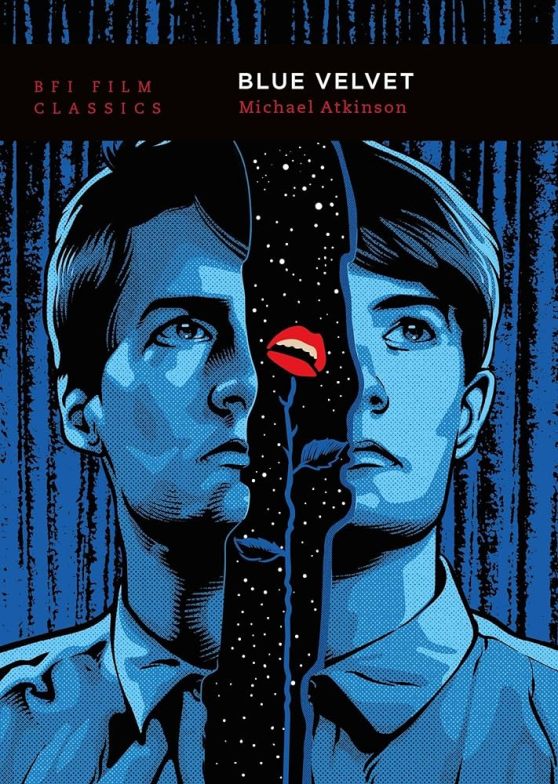
2. Blue Velvet. David Lynch is a polarizing filmmaker. You either love or despise his movies; there’s no in-between. In his masterpiece Blue Velvet, college kid Kyle MacLachlan returns to his North Carolina hometown, falls in love with lounge singer Isabella Rossellini (bad girl) and Laura Dern (good girl), and runs afoul of Dennis Hopper in one of the greatest screen-villain performances ever. If you haven’t seen it, check it out. And if you hate it, don’t complain to me.

And at #1, Body Heat, the first film written and directed by Lawrence Kasdan. Sleazy Florida lawyer William Hurt falls in with a classic femme fatale, Kathleen Turner in a stunning film debut, who eggs him on to kill her husband. It’s a film loaded with great performances (watch for Mickey Rourke as an arsonist), complicated plotting (there’s one point of estates law that just doesn’t make any sense), and some of the most quotable dialogue around. And I can’t forget to mention the perfect noirish score, all windchimes and saxophone, by the great John Barry. The film’s a modern classic.
I hope I’ve turned you on to some new movies. Or at least gotten you to think about revisiting old favorites. A friend of mine once told me he thought movies were “the most mysterious art form.” The films prove that statement: They’re dark and depressing, but you can’t look away. The power of cinema.
 B&S About Movies
You must be logged in to post a comment.