Nearly two years ago, I got the amazing opportunity to speak with Bret McCormick, the director of several of my favorite movies, including The Abomination. Now that Visual Vengeance is releasing his films in some incredible Blu-ray editions, he was nice enough to answer more of my questions about his films and everything else that came up in a two-hour interview.
B&S About Movies: The last time we spoke, The Abomination and Repligator were just getting ready to come out on Blu-ray. What does it feel like to have such incredible versions released now?
Bret McCormick: I’ve got to tell you, my experience with distributors during most of my career was not real pleasant. And to have someone like Rob get on board and be so enthusiastic about putting out some of my old films is incredible. There were a lot of hoops that he had to jump through.
Most distributors would have thrown up their hands a couple of years ago. I am just very grateful and honored that first of all, people still want to see these movies, but secondly, that there is a distributor who really is a fan of this stuff. He enjoys this stuff and doesn’t mind putting his money where his mouth is and really doing a great release on these things.
B&S: I’m excited because so many of these movies only existed in rough quality or bootlegs. To actually be able to own these movies in the best quality possible is a big deal to me. It means more to me than so many movies that are going to be released and re-released this year because some of these movies have been out so many times. These are fresh and new because they haven’t been out in decades.
Bret: I’m thrilled that a new generation of people are going to have a chance to own a copy of these things or to see them on streaming. I’m really grateful that Rob has put together these great packages, including comic books and all of this kind of stuff for the for the Blu-ray releases.
B&S: I’ve become such a big fan of Repligator. For a movie made in under six days, it’s got so many ideas, it moves quick and it’s funny. It gets funnier every time I watch it. I don’t care that it doesn’t have the best quality camera shooting it or the finest special effects. It has ideas!
Bret: Some of the movies that I love most from my childhood are these really obscure, weird little things that just got stuck in my mind for some reason.
B&S: I’m interested in knowing what they are!
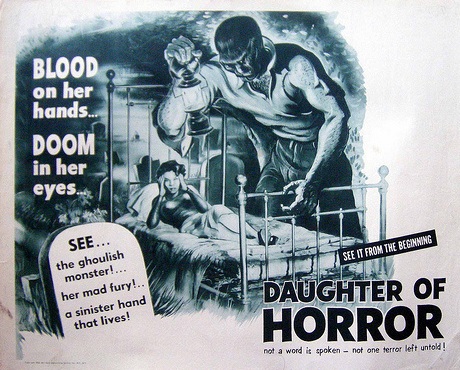
Bret: One of them is a film that people only know from having watched The Blob, the scene in the theater where the Blob comes out of the projection booth. They’re playing a horror movie on the screen that was known under different titles, but one of them was Daughter of Horror. A lot of people have said terrible things about that film, but I think it’s sort of avant-garde and brilliant. I don’t know why but I just think it’s a really great piece of bizarre cult cinema.
B&S: I feel the same about Robot Monster. Sure, people make fun of it. Yet it’s a post-apocalyptic movie when no one quite understood what the end of the world was probably going to be like. They’re trying to work it out on film. Or you could ignore that and laugh at the bad costume.
Bret: Well, it’s a memorable costume. (laughs)
B&S: My entry into genre cinema was the Medved Brothers’ Golden Turkey books and going back now, the movies they hated — Robot Monster, Bring Me the Head of Alfredo Garcia, Zabriskie Point — I love those movies!
Bret: The first time I saw Zabriskie Point on the big screen. Our college film instructor suggested we all go see it together. Man, I loved it because of the fact that it breaks the fourth wall in a very real sense. I mean, that guy that played the lead (Mark Frechette) was an actual sort of revolutionary later. He got arrested for robbing a bank. It blurs the line between movies and reality in a way that was really mind-blowing to me.
Movies leave an imprint that stays with us, even if it’s not particularly high quality.

B&S: A big percentage of the audience that may buy your movies weren’t around for the shot on video or Super 8 eras. How do you think they’re going to react to your films?
Bret: I think a lot of people who are going to be drawn to it are going to be people who have heard about it on the internet. Back in the day when I was a huge horror film fan, a teenager and looking for new stuff to see, I wanted to find out about everything. I read, you know, Castle of Frankenstein, and any kind of publication like that I could get my hands on. Very often, the things that got the worst reviews were things that I insisted that I needed to see. Oh God, if it’s not good I gotta see this. I can’t believe it’s that bad. That’s how I discovered Andy Milligan. (laughs)
B&S: I was going to ask if that’s who you found when you said, “I can’t believe it’s that bad.”
Bret: I went to a fan convention when I was 12 years old in Dallas. It was called D-Con 71. And it was really just a different world for me, you know, and I spent the whole weekend there at the Sheraton Hotel in downtown Dallas. I bought tons of stuff in the vendor room. One of the things I bought was a poster for Milligan’s Bloodthirsty Butchers.
I put it up on the wall. And the house we lived in at that time, the driveway came in off the street and curled around the house. Everybody entered the house by walking through the back door which opened into my bedroom. My grandmother came over and saw that poster and flipped out!
“No 13-year-old boy should have a poster like that on his wall!”
It was sick and disgusting and depraved and it was going to warp my mind in some way. So my mom made me take it down. I kept it in a drawer for a long time and then when I got a little older, I put it back up again.

B&S: I don’t know if we can appreciate the work it took to find genre cinema back then.
Bret: I would talk with other fans, I was pen pals with other fans all over the country because of the pen pals section in the back of the Famous Monsters of Filmland. I had friends who lived on the East Coast, that would tell me about movies that never made it to Texas. And I was always looking for books about these things. There really weren’t even a lot of books back then.
But one thing that I had going for me when I was like 12-years-old was my best friend Roy.
I spent a lot of time over at his house and he had a stepfather who loved horror films. His stepdad would take us to the drive-in to see movies that no other adult that we knew anywhere would have allowed us to see. So I was able at an early age to see some things that I couldn’t possibly have seen otherwise. And you know, some people would consider that poor parenting but I am grateful that I had that exposure at an early age.

B&S: I don’t know if I shared it the last time we spoke, but before we met I was super intimidated. Not just because I love your films so much, but because The Abomination is so on the wavelength of so many obsessions. I thought that you were going to be somewhat deranged to make a movie like that! I don’t mean that as an insult. It’s just such a relentlessly strange film that keeps me coming back to it. Who could make a movie like that?
You were making it in the midst of televangelists ruling late night TV. Like Robert Tilton.
Bret: I had a grandmother who was very into faith healing. She took me to lots of revivals and stuff. I was exposed to a whole lot of that.
B&S: Much like the root of the word occult, these movies have been hidden. People may not have been able to see them.
Bret: There is a certain mystique about it. I am sure a certain percentage of the new viewers will be disappointed. Some will get on board with it and think it’s a fun and crazy thing. A small percentage will say, “God this is creepy and weird.”
You know, like you were saying, before you spoke with me you wondered what kind of a person put a film like that out into the world. And it reminds me of a funny story.
I sell my paintings of a lot of different pop-up venues, you know, and I did this one event. At the end of the day, this guy came up and he was looking at my stuff. He was asking me questions about how many events I did. And then he goes, “How many artists do you represent?” And I said, “Well, I don’t represent any artists. This is all just my work.”
Then he said, “You did that and you did that?” And he’s pointing at all these very different things. And I said “Yeah,” and he said, “Man, it must be creepy to live inside your head.”
I never imagined it would have that effect on anyone but I guess you know… (laughs)
B&S: Well, I’ve got to know you a bit since then (laughs). With all the extras on the Visual Vengeance releases, I feel like I’m getting to learn even more.
Bret: I cannot believe they did five hours of special features! Like I never imagined that would be the case. It will certainly satisfy the appetite of even the most curious fan, I would think.

B&S:I wonder how people will react to some of the gender swapping in Repligator. It feels like at the same time society is both more and less liberal than when you made it.
Bret: I think sexually we’re more liberal than we were at that time. So I think a lot of people are just going to take that aspect of it in stride. Yeah. I think maybe with the military, unfortunately, we’ve kind of gone back to a more conservative position at least all of our mass media has.
I don’t know how many people actually believe the sort of narrative that we receive through our mass media, but right now there’s like a more supportive mindset of the military-industrial complex. Definitely more than when we were coming out of the Vietnam era. Maybe some people will see it as a slap in the face to the military but we didn’t intend it that way.
B&S: I didn’t get that feeling. I got more of a Dr. Strangelove feel.
Bret: That was definitely in the back of our minds when we made it.
B&S: Is it weird that young people today feel more puritanical?
Bret: That’s a predictable process I think. My mom and my dad were extremely materialistic. Because of the influence of the 60s, I kind of went off in a different direction from that. And then my sons both went back toward a more materialistic paradigm. So I think from generation to generation, we kind of track back and forth, looking for the best possible sort of balance between the two extremes.
We all push back against whatever milieu we were raised in. I mean, it’s just a very predictable pattern.
That said, I think one of the ways young people have gone in a different direction is just to be more accepting of everyone’s sexuality.
B&S: As the author of Texas Schlock and a fan of regional horror, I was wondering, if I was someone just starting to get into genre films, what Texas filmmakers should I hunt down?
Bret: I have a soft spot in my heart for Larry Buchanan because he was the first one I knew of and met, but his work runs the gamut. Pretty much like my own does, from incredibly crude to semi-polished and maybe even acceptable as an actual movie.
I think S.F. Brownrigg is definitely in a category by himself and he made some really weird, wonderful drive-in movies. Don’t Look In the Basement was an incredible drive-in phenomenon. For ten years, hardly a week went by when it wasn’t playing somewhere in the Dallas Fort Worth metroplex. It was a very popular movie when it first came out. And then I guess AIP or whoever had it at that time used it as a second feature with just dozens of horror films that came later.
B&S: What about Pat Boyette? He did movies and even created comics for Charlton.
Bret: Yeah, Charlton was always kind of an enigma to me. I really liked The Many Ghosts of Dr. Graves. I would buy Charlton because I think they were a couple of cents cheaper than the other comics. I had a huge stack of Carlton comics and I always wondered what the deal was with them because they had such a different flavor to them. When I found out that Pat Boyette wrote for them and drew some of the comics, I was blown away.
B&S: What made you go from watching movies to making them?
Bret: If I hadn’t seen that article in Famous Monsters of Filmland about these 12-year-old boys making a Frankenstein movie with a home movie camera, I might never have gotten the idea that ‘hey, I could make a movie!’
You never know what little incident is going to spin you off in a totally new direction.

Want to experience Bret’s work?
You can get The Abomination now from Visual Vengeance.

You can also get Repligator from Visual Vengeance.

Bret’s book Texas Schlock examines b-movie, science fiction and horror movies produced in Texas from the late 1950s up to the present day. The films and careers of such cinematic trailblazers as Larry Buchanan, S.F. Brownrigg, Tom Moore, Edgar G. Ulmer, Robert A. Burns, Glen Coburn and McCormick himself are explored from a fun and appreciative perspective.
You can get a signed copy right here and to see all of Bret’s books, check out his Amazon page.

You can also get The Abomination Book here.
Thanks again to Bret for his work and kindness.
 B&S About Movies
You must be logged in to post a comment.