WEIRD WEDNESDAY: The Lost Empire (1984)

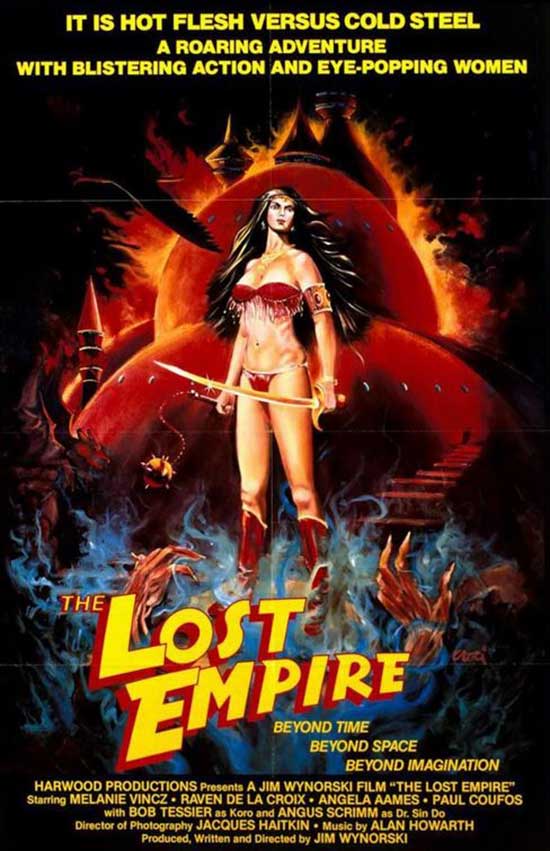
It’s time to stop fighting it and just embrace the neon-soaked, low-budget glory. I am a Jim Wynorski apologist. It’s a support group with surprisingly high membership. Wynorski is the ultimate cinematic high-wire act: a man who realized early on that if you have enough smoke machines, a few former Playmates and a script that moves at 90 miles per hour, nobody cares if the ancient temple is clearly a rented warehouse in Van Nuys.

The director may have flunked out of film school, but he turned an introduction to Roger Corman into a lifelong career. He didn’t just survive the grind of the B-movie circuit; he thrived in it, starting with a writing credit on one of my favorite Corman sci-fi riffs, Forbidden World, and moving on to SorceressScrewballsBeastmaster 2: Through the Portal of Time and so many more.

He stepped behind the camera and never looked back, giving us the mall-horror essential Chopping Mall, as well as Deathstalker IIBig Bad Mama IISorority House Massacre II and III, Return of the Swamp Thing, and 976-EVIL II, another film of his that, yes, I admit I enjoy. I even like his Cinemax After Dark movies, like the Body Chemistry sequels and  Munchie.

So alright. I like his movies. I’ve learned something. I can even respect that he’s gone the way of most horror directors of my youth, alternating between children’s movies like A Doggone Christmas and A Doggone Hollywood with the softcore stuff he’s known for, SyFy-style creature movies and weirdness like Sharkansas Women’s Prison Massacre.

But if every movie Wynorski made was like The Lost Empire? He’d probably be one of my favorite directors.

We start in Chinatown, where three masked intruders try to steal the glowing eye of a statue. Everyone dies in the battle except for one cop, who barely makes it. And then, the next day, terrorists take over a school before Inspector Angel Wolfe (Melanie Vincz, Hunk) takes out everyone, which almost includes an undercover fed named Rick Stanton (Paul Coufos, 976-EVIL II). Luckily, she stops from killing him just in time and then, as is customary in police and federal working relationships, they aardvark.

When they wake up the next morning, Angel and Rick learn that her brother Rob (Bill Thornbury, Jody from Phantasm!) was the police officer who survived the jewelry store shootout. In the hospital, he hands her a throwing star and says, “The Devil exists, and the Eye knows where.” Instead of being freaked out, Rick launches into exposition mode to tell us all about Lee Chuck (when I realized this was Angus Scrimm, I lost my mind), a man who has become immortal yet must give Satan a new soul every day.

Keep in mind that we are about fifteen minutes into this movie, and we’ve already had a cop-versus-ninja battle, terrorists fighting a lone cop, a sex scene and an occult backstory. I already was head over heels for this one.

When Angel examines the crime scene, one of the glowing eyes makes its way into her purse — all on its own — before Inspector Charles Chang (Art Hern, Simon King of the Witches) goes into even more exposition, explaining the Eyes of Avatar, two jewels that the Dragon-God blessed with the power to rule the world. He tells her that Lee Chuck is real, has one eye and has joined the cult of Dr. Sin Do (also Angus Scrimm!).

With her brother dying from his wounds, Angel decides that she must destroy Sin Do, who has begun recruiting an army of terrorists, including Anthony Kiedis’ dad Blackie Dammit and Angel Pettijohn as Whiplash. So she does what any of us would. No, she doesn’t file the paperwork to get a task force and involve multiple police and federal units. She instead learns that Dr. Do — no relation to the video game character Mr. Do, although both have castles — only accepts groups of female soldiers in threes. And that means that she has to bring in her old friend, the Native American supersoldier Whitestar (Raven De La Croix, perhaps the greatest of all Russ Meyer’s women next to Tura Satana; she was also the associate producer, costume designer and animal handler of this movie while doing all of her own stunts) and Heather (Angela Aames, Fairy TalesH.O.T.S.), a convict who she promises to parole — how does she have that power? — if she helps like some nascent version of the Suicide Squad.

Whatever. Logic be damned, the ladies are off for Golgotha, Dr. Do’s castle fortress, where more ninja battles and a cast that includes Robert Tessier (who was one of the four members of Stunts Unlimited along with Hal Needham, Glenn R. Wilder and Ronnie Rondell Jr.), Linda Shayne (Miss Salmon from Humanoids from the Deep who would go on to direct Purple People Eater), Kenneth Tobey (who was in so many movies, like the original The ThingDirty Mary Crazy LarryThe Howling and more), Anny Gaybis (who was in a movie with one of my favorite titles, Wam Bam Thank You Spaceman!) and Tommy Rettig (Jeff Miller from the Lassie series and the star of one of the strangest movies to ever escape Hollywood, The 5,000 Fingers of Dr. T) await.

I mean, this movie is so close to being in the same continuity as Big Trouble In Little China that Alan Howarth did the music for it. I’ll go ever further and say that thanks to Blackie Dammit being in it, it might even be in the same universe as 9 Deaths of the Ninja. It’s a total blast, a movie that is somehow the answer to the unasked question, “What if Russ Meyer directed Enter the Dragon?”

This is definitely the movie to put on if you’re down. I mean, how can you be sad after watching a movie where Angus Scrimm’s bad guy character has a giant snake and can survive losing his head, much less one that features a prison shower flashback just to prove that one of the heroines was in jail at one point and hints that Raven De La Croix has supernatural powers? We’re going to have to go through a black hole and come out the other side to figure out how many I’d give this movie.

You can watch this on Tubi.
WEIRD WEDNESDAY: The Losers (1970)

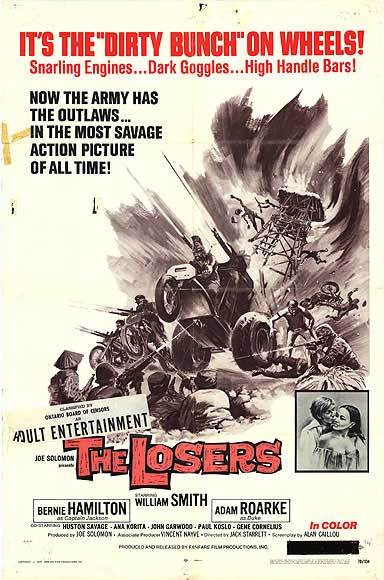
Also known as Nam Angels, this Jack Starrett-directed film (he also made Run, Angel, Run!Race with the Devil and Hollywood Man, among others) has a great high concept: a biker gang called The Devil’s Advocates is sent to Cambodia to rescue an American diplomat because they are the only ones who can get the job done.

They’re led by a Vietnam vet — and the brother of the Army Major who has recruited them — Link Thomas, played by the always dependable William Smith. They’re under the orders of Captain Johnson (Bernie Hamilton, who was Captain Harold Dobey on Starsky and Hutch) and include fellow vets Duke (Adam Roarke from Dirty Mary, Crazy Larry and Frogs) and Dirty Denny, as well as Limpy (Paul Koslo, Vanishing Point) and Speed (Eugene Cornelius, who was Space in Run, Angel, Run!).

They head to Vietnam,  but come on, we all know it’s the Philippines because the mechanic who works on their bikes, Diem-Nuc, is played by Vic Diaz. It doesn’t matter because by the time you start trying to figure out locations*, our heroes are doing wheelies and blowing things up with rocket launchers and machine guns while they do wheelies.

This movie does have some basis in reality. Sonny Barger, the Maximum Leader of the Hells Angels, sent LBJ a telegram offering the skills of his club in the Vietnam War. That inspired Alan Caillou, who originally wrote that The Losers would live. Starrett and Smith rewrote the script to the ending we know now.

If you watch Pulp Fiction, you can see a scene from this movie being watched by Butch’s girlfriend the day after his fight. When he asks what she is watching, she says, “A motorcycle movie, I’m not sure the name.”

Smith was a real-life Renaissance man: a champion arm wrestler, a record holder in reverse curling with 163 pounds ad a 31-1 amateur boxing record. Take it from Miles Spencer: “Fluent in five languages, he held a PhD and served as a Russian intercept interrogator during the Korean War. With both CIA and NSA clearance, he flew secret ferret missions over Soviet Russia.”

When he commands a biker gang in the jungle, you don’t question it. Just like how he makes every movie better just for being in it.

Most biker movies of the era were about terrorizing small towns. The Losers is unique because it attempts to give these outcasts a sense of warped patriotism. They aren’t fighting for The Man. They’re fighting for their brother and for the thrill of the chaos. The nihilistic ending reinforces the title: in a war like this, even the heroes are just losers in a different uniform.

*They’re reused from Too Late the Hero.

You can watch this on Tubi.
WEIRD WEDNESDAY: L.A. Streetfighters (1985)

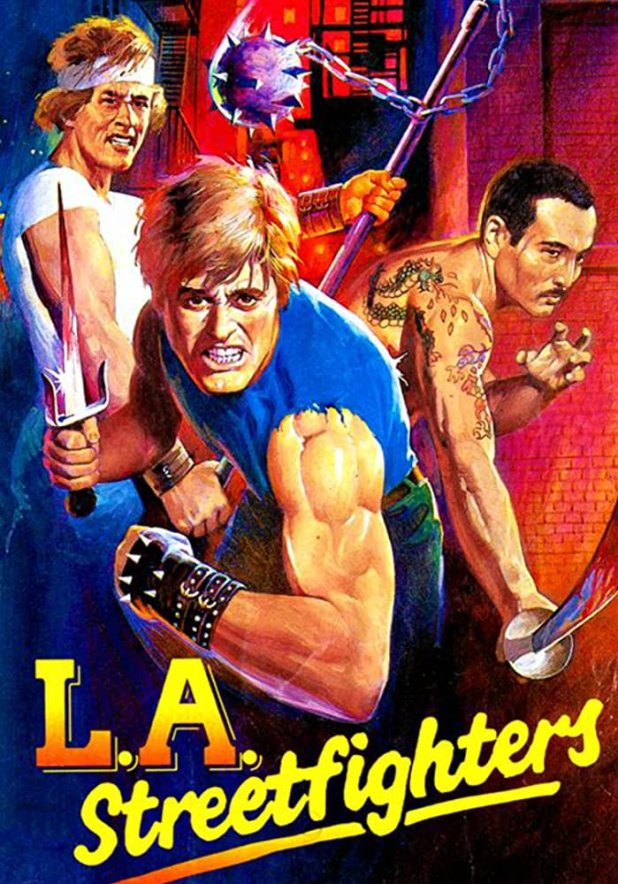
Also known as Ninja Turf, this was directed by Woo-sang Park, who, as we all know, directed Miami Connection. It’s about new kid at school Tony (Phillip Rhee, who created and starred in the Best of the Best series of movies) and how he instantly vibes with a gang leader named Young (Jun Chong, whose company Action Brothers Productions made this movie happen; he’s a celebrity martial arts trainer who taught Sam J. Jones, Lorenzo Lamas and Phillip Rhee). Their friendship is enough to get him threatened by another gangster, Chan (James Lew). In the middle of Young saving Tony, they get offered a job as security guards. Yes, that can happen.

In between their security gigs, they rumble with the Blades and Spike’s Gang, which has Biff Tannen as a member. It is genuinely jarring to see Thomas F. Wilson (credited as Tom Wilson) playing a member of Spike’s Gang. Released the same year as Back to the Future, this film shows a version of Wilson that is arguably meaner than Biff. In Ninja Turf, he isn’t a cartoonish bully getting hit with manure; he’s part of a legitimate urban threat. Seeing him in a world where people actually get stabbed creates a strange cinematic cognitive dissonance.

But when they’re not fighting, Tony hooks up with Chan’s sister Lily. This enrages his enemy and his friend, too, as all Young can think about is feeling alone. And oh yeah, his mom, who lives to drink and sleep with men.

Young has some issues. He also screws up when those issues get to him, as he and Tony do security for a mob boss, and he steals a briefcase filled with money from a drug deal. That boss sends a swordsman named Yoshida (Ken Nagayama) and a fighter called Kruger (Bill “Superfoot” Wallace). They meet up with Chan, who eagerly tells them where to find his enemies, and they even torture a whole bunch of Tony and Young’s school buddies. They catch up with Young, who kills Yoshida and breaks Kruger’s knee, all while Tony is studying.

On the way to the hospital with his injured friends, Young is stopped by Chan and his entire gang. His mother comes out into the street and tells him that she’s sorry for everything she’s ever done, and, wow, Chan beats her into oblivion while her son watches. Then, the gang brutalizes him, and Tony gets there too late. Grabbing his friend’s wooden sword, he chases away the gang and probably kills Chan. 

The death of Young is one of the meanest pivots in 80s action. Usually, the best friend dies to give the hero a reason to win a tournament. Here, Young dies because of a series of desperate, human mistakes—stealing money to escape a life that was already suffocating him. When Tony holds him at the end, it’s not just a friendship moment. Instead, this is the immigrant promise croaking out a death rattle. They came for a better life and found James Lew and a briefcase of death instead.

Jaime Mendoza-Nava, who wrote this movie with Ji-woon Hong, was mostly known for composing music for films and TV shows. Some of the 300 works he contributed to include music for The WitchmakerThe StewardessesDream No EvilGrave of the VampireThe Town That Dreaded SundownMausoleum and Death Wish Club, which is really “The Case of Gretta Connors” from Night Train to Terror.

This isn’t as amazing as Miami Connection, but it’s the dark, opposite-coast version of friendship amid street fights. It’s a lot of fun, even if the ending is nihilistic pain.

You can watch this on Tubi.
WEIRD WEDNESDAY: The Loreley’s Grasp (1973)

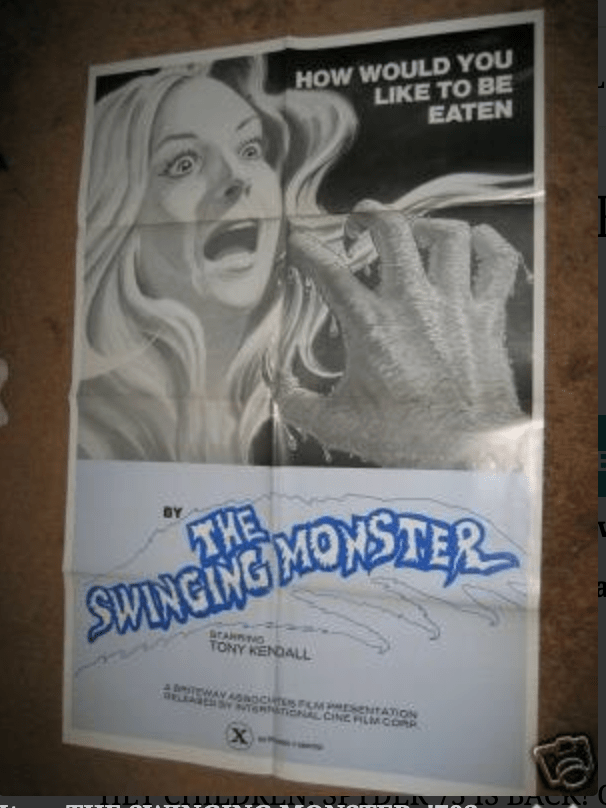
As you know, I do love alternate titles. This was known in the U.S. as When the Screaming Stops and even better, The Swinging Monster, both titles that make no sense, what with this being set in an indeterminate time and the only swinging coming from how many gorgeous women are in it. That said, the first other title got a gimmick from distributor Independent Artists, who added Shock Notice, turning the screen red with flashing lights before each murder.

This was more than just a creative flourish. It was a desperate marketing ploy by Independent Artists to compete. Similar to William Castle’s Percepto”or the Bell System”in other films, the red-tinted screen served as a psychological trigger. It essentially told the audience, “Put down your popcorn and look up, something expensive and messy is about to happen.” It turned a standard creature feature into a sensory assault, bridging the gap between a gothic fairy tale and a proto-slasher.

Directed and written by Amando de Ossorio, this is about a German boarding school for girls — parents, don’t send your babies to German boarding schools — where the young ladies are getting murdered in such bloody and horrifying ways during every full moon. This leads the teacher, Elke Ackerman (Silvia Tortosa, Horror Express), to hire a hunter named Sigurd (Tony Kendall, The Whip and the Body) to protect her pupils. Ossorio juxtaposes the sterile, buttoned-up environment of the boarding school with the wet, neon-lit grime of Loreley’s grotto. It’s a visual representation of the 1970s struggle between traditional morality and the burgeoning sexual revolution.

Each night, Sigurd patrols the school grounds — noticing the many gorgeous students under his protection, naturally — before he meets Sigurd a cloaked woman (Helga Liné) that he keeps missing despite chasing her. He also meets Professor Von Lander (Ángel Menéndez), who has made a dagger that can transform the creature the Loreley back to her human form. And as you can imagine, he’s already fallen for her, despite his job and the fact that she’s killed numerous people.

Sigurd is also in love with Elke — maybe he’s The Swinging Monster — and Loreley has already gone after her while restraining him in the undersea cave where she lives with an army of feral women. It’s an entire world removed from our own, like another time and place, which our somewhat modern man destroys with bombs before leaving behind the monstrous world and embracing a love of reason. I’m not so sure I’d make the same choice.

I’ve read a lot of reviews that make fun of this movie, that say it has bad effects, that it’s kind of stupid. Those people are small-minded, sad folks who can’t embrace the world of Eurohorror, where every man looks like a superhero, and every young girl’s bodice is practically either ripped open or covered in blood. A world where gorgeous women lie in wait inside lagoon caves, ready to transform and destroy.

Critics who pan this for bad acting or an illogical plot are missing the point. This isn’t a movie you watch for a tight script; it’s a movie you experience for the Technicolor blood, the insane creature design and the sheer audacity of a plot that treats a lizard-woman heart-thief as a legitimate romantic rival.

WEIRD WEDNESDAY: Lord Love a Duck (1966)

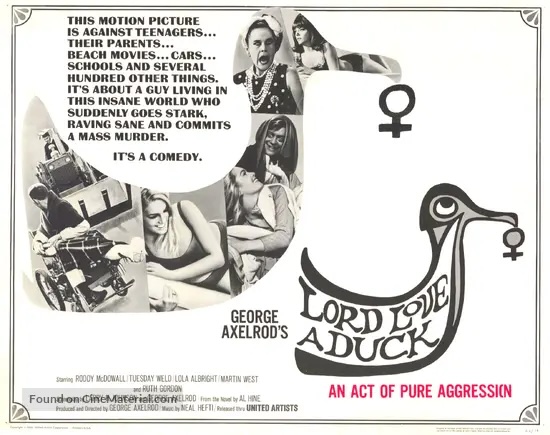
If you’ve ever wondered how the sugary, surf-sprayed innocence of the Frankie and Annette era curdled into the nihilistic, neon-soaked cynicism of the 1970s, look no further than George Axelrod’s Lord Love a Duck. This isn’t just a movie. It’s a scorched-earth policy directed at the American Dream, wrapped in a high school blazer and smelling of desperation.

Alan Musgrave (Roddy McDowall) has spent an entire year fulfilling the dreams of Barbara Ann Greene (Tuesday Weld). Anything to keep her from becoming her mother (Lola Albright), an aging waitress whose life has long passed by. Whether that means Barbara Ann getting to join an exclusive sorority, dropping out of school or marrying Bob Bernard (Martin West), Alan makes it happen. Alan is a Svengali. He doesn’t want to date Barbara Ann; he wants to curate her. When she needs thirteen cashmere sweaters to fit in with the in crowd, he gets them. When her mother stands in the way of Barbara’s social ascent, Alan helps her out of this mortal coil. He frames her suicide as an accidental drowning because, in Alan’s world, a dead mother is a tragedy, but a suicide is just bad PR.

Then, Barbara decides she’s going to be a star and T. Harrison Belmont (Martin Gabel) wants her to star in his beach movies. Bob says no, so of course he’s out. Alan tries to kill him so many times that the boy ends up in a wheelchair, only for Alan to finally kill him and most of their graduating class with an excavator. Barbara Ann lives, stars in Bikini Widow and Alan is sent to prison.

But he did it all for love.

With roles for Ruth Gordon, Harvey Korman, singer Lynn Carey, Frankenstein’s Daughter monster Donald Murphy, Sybil‘s mother Martine Bartlett, 1965 Playboy Playmate of the Year Jo Collins, Dave Draper (the body builder who became movie host David the Gladiator on KHJ Channel 9 in Los Angeles and showed peplum films) and Donald Foster (often a neighbor on shows like Hazel), this was directed by George Axelrod. He directed only one other movie, The Secret Life of an American Wife, but is best known for writing The Seven Year Itch and Will Success Spoil Rock Hunter?

McDowell was in his late 30s when he made this, yet he played a teenager. Weld was 22. And who can say what kind of movie they were in? It’s more darkness than farce, a movie where Alan does everything to make Barbara Ann happy and asks nothing in return. It’s like he enjoys being a source of anarchy and chaos, as long as she’s happy. 

I always wondered how we went from beach movies to early 70s New Hollywood. This may be the connection.

Lord Love a Duck is the bridge between the malt shop and the Manson family. It’s a movie where the protagonist is a high-functioning sociopath, and the heroine is a void of pure consumerist greed. McDowall is genuinely unsettling as he plays the role with a frantic, wide-eyed devotion that suggests that, unlike every other male in this movie, Alan doesn’t even want to touch Barbara Ann.

He just wants to watch her consume the world.

WEIRD WEDNESDAY: The Long Goodbye (1973)

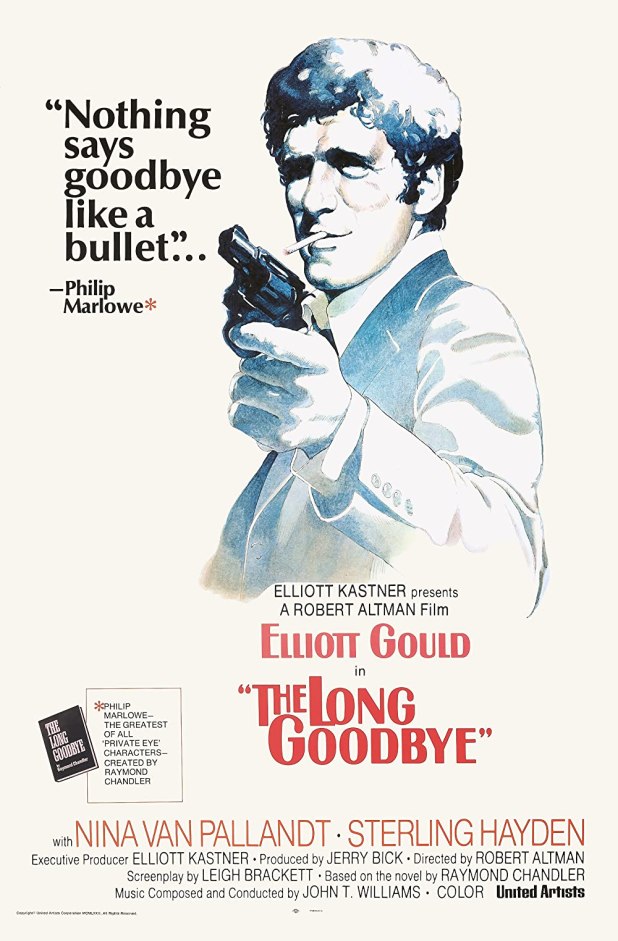
Directed by Robert Altman and based on Raymond Chandler’s 1953 novel, with a script by Leigh Brackett (who co-wrote the screenplay for Chandler’s The Big Sleep), who said that United Artists demanded that “either you take Elliott Gould or you don’t make the film. Elliott Gould was not exactly my idea of Philip Marlowe, but anyway, there we were.” — The Long Goodbye was revised to move the story to the 70s.

As for Gould, he hadn’t worked in two years, ever since battling with Kim Darby and director Anthony Harvey on A Glimpse of Tiger. He had to take a psychological examination before United Artists would sign him to the lead role.

Marlowe (Gould) is asked by his friend Terry Lennox (baseball player and author of Ball Four, Jim Bouton) to take him to the border at Tijuana. When he gets home, the cops bring him in and question him about Lennox killing his wife, Sylvia. After three days in jail — and refusing to help the police — Marlowe learns that Lennox is said to have committed suicide. He refuses to believe that story.

Marlowe is hired by Eileen Wade (Nina van Pallandt, who dated Hughes diary forger Clifford Irving and sings “Do You Know How Christmas Trees Are Grown?” in On Her Majesty’s Secret Service) to find her missing husband Roger (Sterling Hayden, who was drunk and stoned for most of the movie; he’s still great), which takes the detective — who never stops smoking — into the health and fitness world of well-off Californians. And of course, the Wade and the Lennox couples knew one another, as Eileen confesses that Roger was sleeping with Sylvia, and might have killed her, right after Roger walks into the sea and drowns. Oh yeah — there’s also the matter of mob boss Marty Augustine (Mark Rydell), who has some money owed to him by Terry.

All paths lead back to Mexico, where Marlowe soon realizes that he’s been played for a fool. However, he plans on having the last laugh. Altman referred to his character as Rip Van Marlowe, seeing him as a man trapped in the 50s and “trying to invoke the morals of a previous era.”

The cast also includes David Arkin, Pancho Córdova, Amityville 2 and Mommie Dearest star Rutanya Alda, Jack Riley, David Carradine, Morris the Cat and a non-speaking role for an impossibly young Arnold Schwarzenegger.

Critics savaged this on initial release, with Jay Cocks from Time saying, “It is a curious spectacle to see Altman mocking a level of achievement to which, at his best, he could only aspire.” Chris Champlin of the Los Angeles Times summed up what so many thought of Gould as Chandler’s hard-boiled detective hero by writing, “He is not Chandler’s Marlowe, or mine, and I can’t find him interesting, sympathetic or amusing, and I can’t be sure who will.”

As for the actor, he has said that, as long as he is physically able, he hopes to reprise the role. He has a screenplay entitled It’s Always Now based on the Chandler story “The Curtain.” The Chandler estate sold him the rights for $1.

With an always-moving camera and the pastel cinematography of Vilmos Zsigmond, this movie still looks wonderful and has stood the test of its time, a time when it was not as well considered.

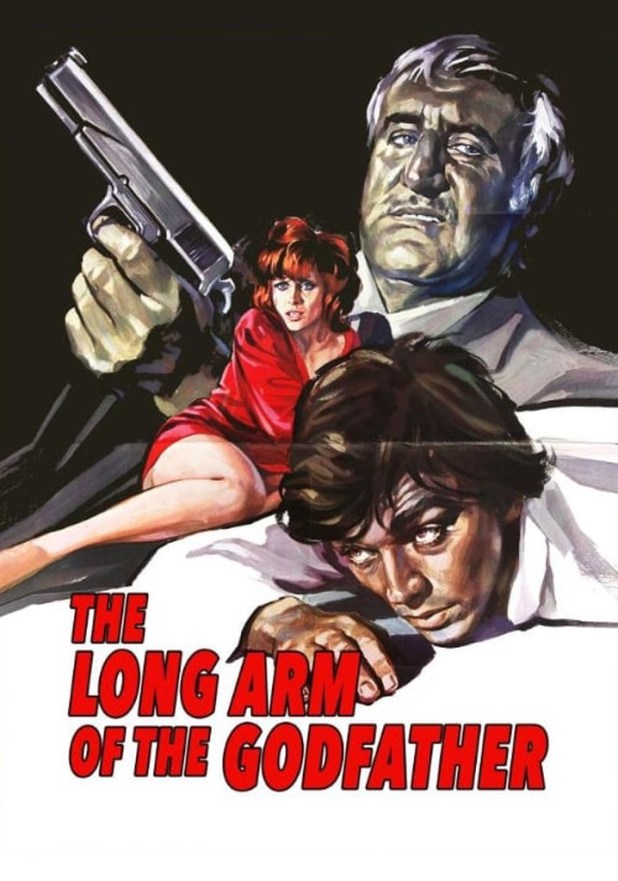
WEIRD WEDNESDAY: The Long Arm of the Godfather (1975)

The movie opens with a high-stakes military heist that feels more like a war film than a mafia flick, as Vincenzo (Peter Lee Lawrence) and his crew ambush an army convoy to steal a crate of rifles. Vincenzo’s fatal mistake isn’t just stealing from Don Carmelo (Adolfo Celi); it’s his arrogance. He believes he can outmaneuver the seasoned Don by selling the hardware to a group of Arab insurgents.

The middle act shifts the tension to a claustrophobic hotel in North Africa. This change of scenery distinguishes the film from other Italian crime movies of the era that rarely left the streets of Rome or Milan. The Middle Eastern subplot adds a layer of political cynicism, suggesting that Vincenzo is out of his depth not just with the Mafia, but with international arms dealing.

But you know how these Italian crime movies end. Not always well, you know? Maybe he should have just stayed at that hotel with his girlfriend, Sabina (Erika Blanc), and forgotten about a life of crime.

Nardo Bonomi (sometimes credited as Leonardo Bonomi) is a ghost in film history. This is his only officially released directorial credit. While he brings a surprisingly energetic eye to the action, this is one mean-spirited film. Vincenzo isn’t a hero, but an amoral social climber who uses his girlfriend Sabina’s jewelry to fund his escape.

His other project, Sortilegio, remains one of the great holy grails of Italian cult cinema. The fact that it was co-directed by Corrado Farina (the visionary behind the psychedelic Baba Yaga) suggests Bonomi had a foot in the more avant-garde side of Italian filmmaking before disappearing from the industry entirely. This movie starred Erna Schürer as a woman given to waking nightmares. It was completed, assembled and dubbed, but never arrived for censorship approval and went unpublished. Four Flies Records released the soundtrack, saying,One of the most mysterious movies that came out from the golden age of Italian cinema, its soundtrack was recorded in 1974. The movie had never been officially distributed and was probably never taken to the final stage of post-production. The film is lost, gone forever apparently.” 

Peter Lee Lawrence was often criticized by contemporary critics for being too pretty or wooden, but in The Long Arm of the Godfather, his youthful, clean-cut looks work perfectly. He plays Vincenzo as a man whose ambition far exceeds his intelligence. At the time of filming, Lawrence was already nearing the end of his prolific but short career. The headaches — he died in 1974 at the age of 30 — he suffered during his final years make his frantic, high-energy performance here feel somewhat haunting in retrospect. He was married to Cristina Galbó, who may be best known for playing Elizabeth in What Have You Done To Solange?

You can watch this on Tubi.

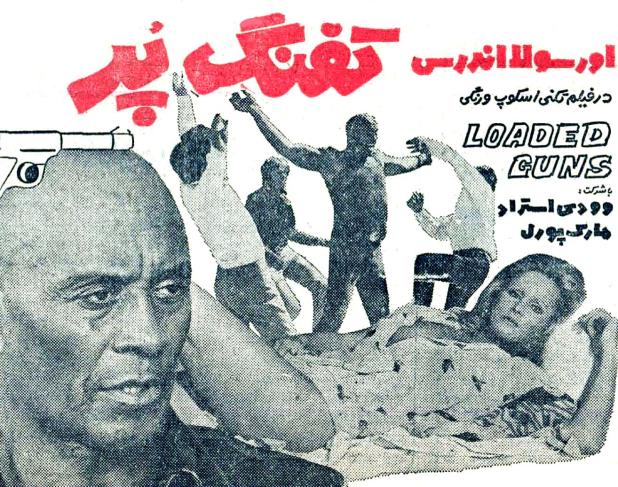
WEIRD WEDNESDAY: Loaded Guns (1975)

Nora Green (Ursula Andress) is a flight attendant who is asked to deliver a letter to a circus led by Silvera (Woody Strode) when she lands in Naples. This gets her in the middle of a gang war. She’s beaten up and thrown to what should be her doom, but she somehow survives. Working with a former circus acrobat, Manuel (Marc Porel), she puts multiple bad guys — there’s Silvera, as well as Don Calo (Aldo Giuffrè) and the mysterious Americano — against one another and looks gorgeous doing it. Luckily, they find another partner in Rosy (Isabella Biagini), who has been the lover of nearly all these gangsters.

Known in Italy as Colpo in canna, this is a fascinating departure for director Fernando Di Leo. While he is the undisputed master of the gritty, nihilistic Poliziotteschi genre — he made Caliber 9The Italian Connection and Blood and Diamonds and wrote one of my favorite parodies of the genre, Live Like a Cop, Die Like a Man — this film sees him blending his signature violence with a lighter, almost comic-book tone that leans heavily on the charisma of its lead.

While Di Leo’s “Milieu Trilogy” (Caliber 9, The Italian Connection, and The Boss) is defined by cold-blooded betrayal and urban decay, Loaded Guns feels more like a colorful caper. Di Leo pivots Nora into a femme fatale superwoman archetype. Unlike the doomed protagonists of his other films, Nora is proactive and resilient; she isn’t just a victim of the gang war. She becomes its architect, deliberately whispering in the ears of rival bosses to ensure they wipe each other out.

This ends with a fun brawl that involves the entire cast, including Andress, who did her own stunts. She’s beyond ravishing in this, reminding you that she was not just a Bond girl, but the first of them all. She plays Nora with a wink to the camera, balancing the high-fashion glamour of a flight attendant with the grit of a woman who can take a beating and come back swinging.

You can watch this on YouTube.

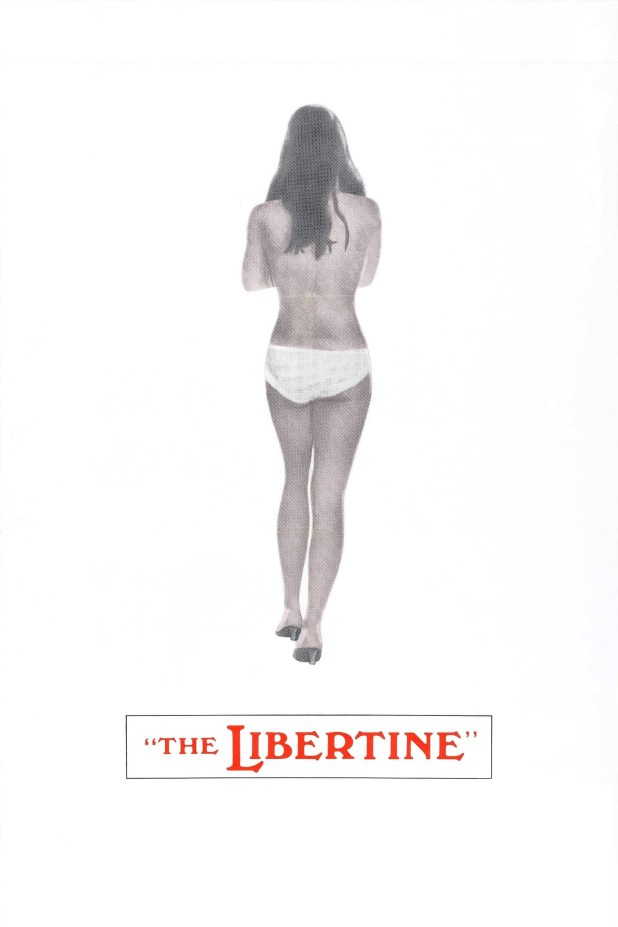
WEIRD WEDNESDAY: The Libertine (1968)

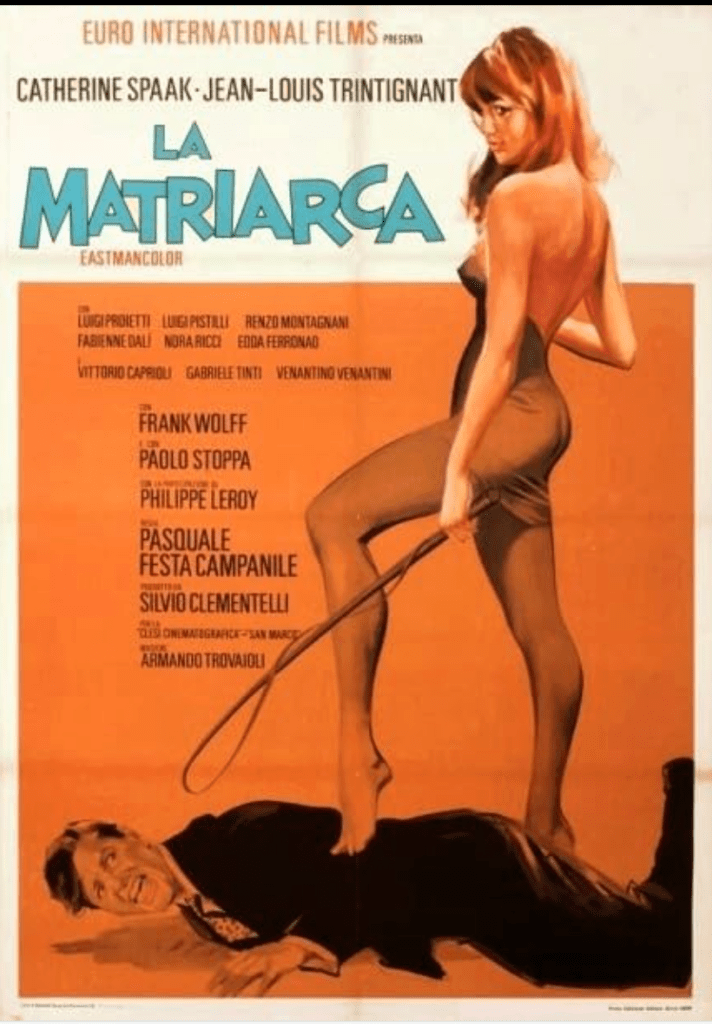
In the rigid, Catholic-guilt-soaked landscape of late 60s Italy, a widow wasn’t supposed to do much besides wear black, weep over a portrait of her departed husband, and perhaps consult a priest about her loneliness. But Mimi (the ethereal, wide-eyed Catherine Spaak) isn’t interested in the script society wrote for her. When her husband, Franco, kicks the bucket, he leaves behind more than just a grieving widow; he leaves a secret high-tech bachelor pad equipped with a little black book, instead of sharing his fantasies with her, that he kept a lair where he could cheat on her.

Instead of burning the apartment down in a fit of rage, Mimi decides to use it as a laboratory. If Franco spent his life grading women on a scale of imagination, experience, talent and cooperation, why shouldn’t she do the same to the men of Italy?

Now, in the place where her husband sinned while striving to keep her pure, everything changes.

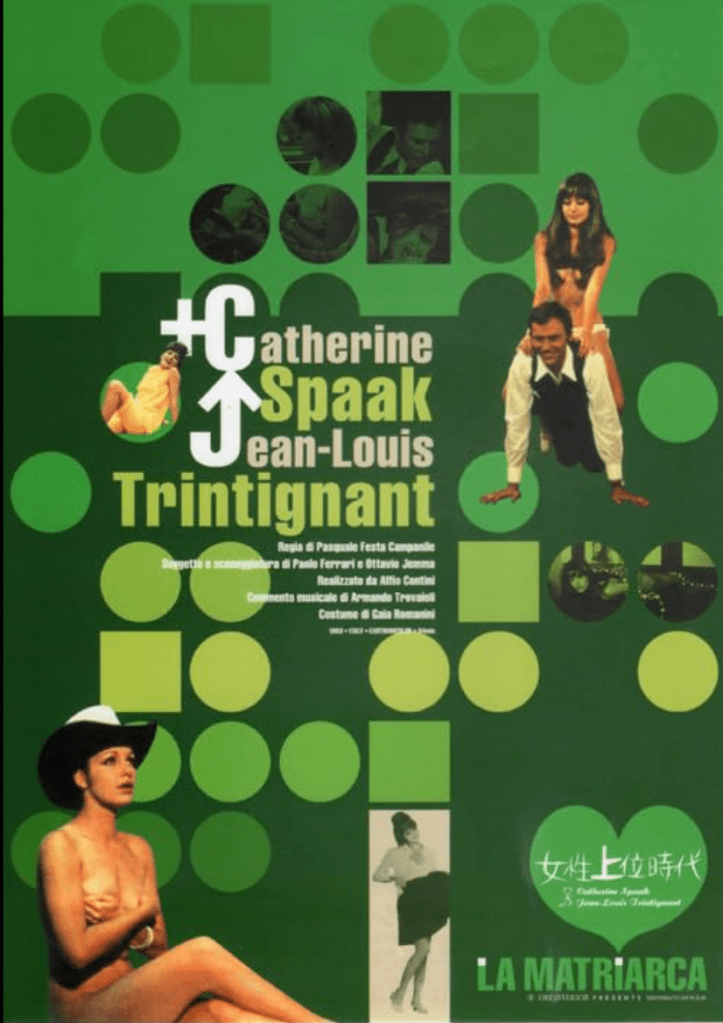
Directed by Pasquale Festa Campanile, best known for his commedia all’italiana like Il merlo maschioWhen Women Had Tails and When Women Lost Their Tails, as well as the harrowing Hitch-Hike, this is about a woman going from an affection-negative marriage to finding love — or lust — everywhere.

Luckily, she finds the perfect partner in Dr. Carlo De Marchi (Jean-Louis Trintignant), a man who can match her kink for kink, but more importantly, wants to connect with her outside of the bedroom. Other conquests include Philippe Leroy as a tennis instructor who can’t get aroused when she’s the one who comes on to him; Italian Western tough guy Luigi Pistilli; Pistilli’s The Great Silence co-star Frank Wolff playing a dentist; Renzo Montagnani, who was Maluc in Campanile’s caveman nudie cuties and the man who would marry Black Emanuelle for real, Gabriele Tinti, playing a man who thinks Mimi is a prostitute. The biggest problem is that she instantly sleeps with her husband’s business partner, Sandro (Gigi Proietti), who claims her as his property and even refers to her as a whore, as mentioned above.

I love this movie because somehow, it came out in 1968 Italy and yet represented a step forward — not always, I get that there are still issues in this, but what do you expect from a male-made Italian sex comedy? — in the way Italian films, much less Italians, saw a woman owning her sexuality.

On Movie-Censorship.com, I found a line about this movie that I love: “Without drifting into the vulgar, she experiences various sexual styles until she discovers her favorite fetish in piggyback.” That’s why in Germany, this was called Huckepack (other amazing titles include The Aristotle PerversionSekso Manyak or Kadının İntikamı or Garip Duygular (Good Sex or The Woman’s Revenge or Strange Feelings in Turkish); Änka i trosor (Widow In Panties in Swedish); Una viuda desenfrenada (An Unbridled Widow in Russian, which is a nice play on the position and conceit of this film) or the best of all these titles, The Era of Female Dominence.

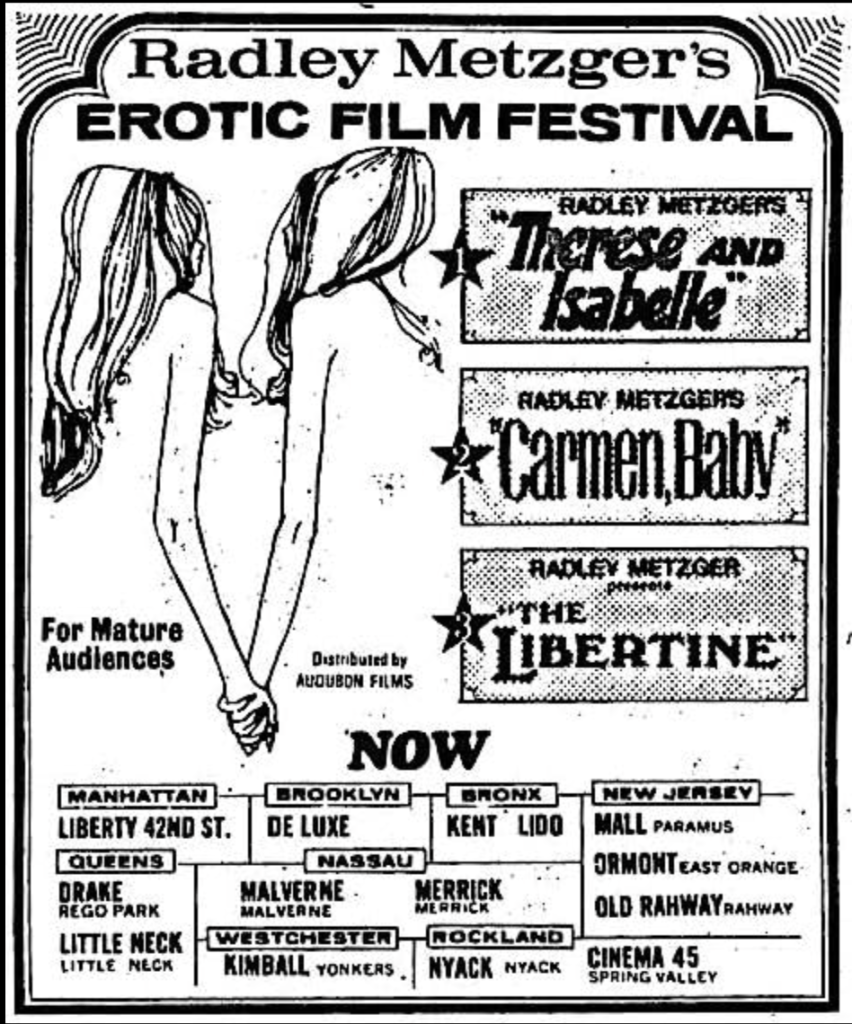
In its native Italy, this flick is La Matriarca. Think about that word. The Matriarch. It drips with the heavy, incense-laden weight of the Italian family unit. It suggests a woman taking the throne, perhaps with a rolling pin in one hand and a rosary in the other. But then, it hits the States. Audubon Films, owned by Radley Metzger, knew they had a movie with Spaak nude, a blonde Italian sex goddess with eyes that could melt a Cinecittà camera lens, so instead of making a statement, they went with The Libertine.

To the Italian audience, she’s a woman reclaiming her power within the structure of her life; to the US grindhouse and art-house crowd, she’s just another bad girl on a sexual odyssey. Italy gives us the status, and America gives us the sin. Actually, Italy gives us a lot of sin, but I digress.

Audubon Films also gave us way more nudity, mostly more of Fabienne Dali from Kill, Baby… Kill!

I don’t like that Dr. Carlo becomes such a jerk at the end of the movie, because I would much rather he came to Mimi on her terms and wasn’t so rude. There was no need to destroy the secret sex apartment, which is incredible and could only exist in Italian movies. That pad is a masterpiece of 60s Italian production design, a space where the rules of the outside world don’t apply.

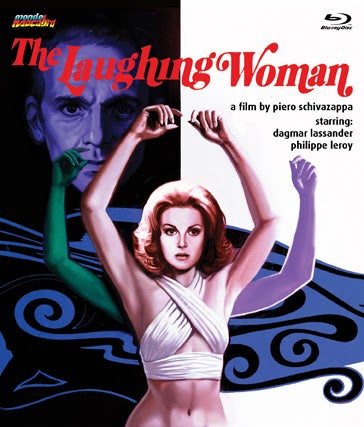
WEIRD WEDNESDAY: The Laughing Woman (1968)

I’ve spent years staring at the iconography of this film, specifically that haunting, colossal sculpture of a woman whose thighs form a gateway to a rolling skeleton. You worry, after seeing imagery that potent, that the film itself will be a hollow vessel. But The Laughing Woman isn’t just a movie; it’s a vibrant, pop-art masterwork that actually manages to be even stranger and better than that one bravura moment.

Maria (Dagmar Lassander) works in the office of Dr. Sayer (Philippe Leroy), who claims to be working in philanthropy but really believes in an increasingly wild series of conspiracies like how every woman in the world is against him and they’re all collecting the sperm of men so they can get rid of them after harvesting their life-giving sperm and that governments are planning on making men obsolete.

After having a drink with Sayer, Maria wakes up chained to a bed and his prisoner, being told that he can make her do anything he wants, and when he’s done, like so many other women, he will just get rid of her, move on and do it all over again.

Directed and written by Piero Schivazappa, this movie takes the expected BDSM idea that an independent woman is going to enjoy pushing her boundaries and fall for her captor and instead flips it like a kink-friendly Arabian Nights, as Maria keeps talking and pushing and prodding Sayer, making him question who he is and what he’s doing.

The world that this happens inside is the kind of future that we were promised and never got, a push-button retro tomorrow that never got here, filled with starkness, strange human forms and swimming pools that are either havens for torture or passion. There’s also a strange bed that Maria soon learns allows Sayer to sleep next to her even when she thinks she’s all alone. And then he makes her make love — with his direction — to his exact mannequin duplicate.

How strange it is that there’s a major inversion before the end of this movie, between who is in charge and who controls who and the traditional top and bottom roles and wow, when Maria pulls off her short wig — Sayer had previously chopped all of her hair — to reveal her flowing locks again, it’s beyond perfect. I was ready for what would happen, but somehow still so happy that it all played out this way, because yes, it had to play out this way.

Sometimes, style and substance fight it out, argue, and no one wins. And other times, they just decide to stop fighting and start fucking, and the results are glorious. This would be that time.